Bizzdesign Connect North America 2026

Bizzdesign Connect North America

September 17, 2026

9:30AM CDT / 10:30AM EDT 

Virtual Event

Register Now!
See the agenda
Info-Tech Research Group
Chief Architect Network

Where AI Meets the Moment of Decision

Enterprise Architecture is becoming more strategic, more intelligent, and more central to how organizations operate. The question is whether yours is keeping pace.

By the time enterprise context enters the conversation, the window to influence direction has already closed. Priorities are locked in. Investments have moved. Risks are no longer hypothetical.

What are the biggest challenges to achieving ROI from AI?

Discover 4 Steps to Improve AI ROI and Governance.

AI Portfolio Governance in 7 Steps

AI Portfolio Governance in 7 Steps

A Practical Guide for Enterprise Architecture and Strategic Portfolio Management Teams

Summary

What you'll learn in this guide: 

  • Why governing AI requires a different approach from managing a conventional application portfolio, and what that means in practice. 
  • How to structure an AI portfolio so that every use case, feature, model, and technology is visible, accountable, and traceable from business intent down to the technology stack. 
  • Who needs to be involved and what each role is responsible for. 
  • A seven-step process for bringing the AI portfolio under governance, from the first application assessment through to a complete, connected view of the full AI architecture. 
  • What a governed portfolio makes possible: responsible AI practices, better risk and investment decisions, and the ability to direct resources toward the initiatives that matter most.


AI has entered the enterprise faster than the organizational discipline to manage it has developed. Business units adopt AI through embedded functionality, decentralized experimentation, and business-led tools, often outside any formal approval process. The result is an AI landscape that's difficult to see clearly and harder still to govern.
Without a shared framework to track and govern it, fundamental questions become difficult to answer: What AI do we have? Who approved it? Where is it permitted to operate? What business priority does it support? And is it working?

FAQs

Start with your application portfolio. Flag all applications that are providing AI features, then document the AI features each one delivers, the models powering them, and the technologies those models rely on. This four-layer structure, covering AI use cases, AI features, AI models, and AI technologies, gives you a complete and traceable picture of AI across the enterprise. Tools like Bizzdesign Alfabet are built specifically to capture and govern this structure, giving organizations a single source of truth for AI usage across the business.

The goals are the same: align investments to business strategy, reduce risk, and keep costs in check. What's different is the entity being governed. An application is a discrete, definable object with a clear owner and a known user base. AI manifests across the organization in multiple forms simultaneously, at the level of the business use case, the feature that delivers it, the model that powers it, and the underlying technology. Each layer needs to be documented and governed separately, which is why AI portfolio management requires its own structure.

Enterprise architecture defines how an organization's strategy, processes, data, and technology fit together. In the context of AI governance, EA plays three critical roles: it connects AI use cases to business capabilities and portfolio priorities, it establishes the architectural framework and standards for AI adoption, and it ensures traceability from AI use cases all the way down to the underlying technology stack. Without EA, AI governance lacks the structural foundation to be consistent or defensible.

Effective AI governance requires five connected roles. The Application Owner flags AI-enabled applications and defines their AI-driven features. The Technology Architect identifies the technologies behind AI models and categorizes what's in use. The CTO and AI Competency Center ensure adoption stays aligned with business goals. The Enterprise Architect designs the governance framework and sets standards. The Risk and Compliance Manager ensures regulatory compliance across the portfolio. None of these roles works well in isolation, and all five need a shared view of the portfolio to function as a governance system. Bizzdesign Alfabet provides that shared view, with predefined business questions and executive-ready reporting built in.

If you can't answer basic questions about your AI with confidence, you need one. Specifically: Can you produce a complete list of AI running across the enterprise? Do you know which use cases have been formally approved and by whom? Can you trace any AI feature back to the model powering it and the technology beneath that? Can you show which business priority each use case supports and whether it warrants continued investment? If those questions require significant effort to answer, or produce different answers depending on who you ask, the portfolio isn't under governance.

Shadow AI refers to AI tools and workflows being used across the organization without the knowledge or oversight of IT, EA, or risk functions. It typically spreads through embedded AI features, independently acquired tools and business-led experimentation outside formal technology and approval processes. Getting it under control requires enterprise-wide standards that define how AI can be used, by whom, and within what boundaries, combined with a connected view of what's been deployed across the application landscape. Bizzdesign Alfabet supports this by tracking AI-specific attributes across applications and components, making it possible to identify ungoverned AI and bring it into the portfolio.

Building a governed AI portfolio follows seven steps, each one adding a layer of visibility and structure. Start by flagging all applications providing AI features, then document the AI features each one delivers and assess their risk levels. Map those features to their providing applications, then document the AI use cases they support and define the approval process. Create an inventory of approved AI models by location and jurisdiction, map those models to the features and components they power, and finally define the AI technologies being provided by those models. Each step builds on the last, moving from application-level visibility through to a complete, traceable picture of the full AI architecture. Bizzdesign Alfabet's AI Portfolio Management Accelerator is designed to support this process, with preconfigured structures and views that make each step faster to execute and easier to maintain.


AI Is Raising the Stakes for Strategic Portfolio Management

AI Is Raising the Stakes for Strategic Portfolio Management

May 28, 2026 - Conrad Langhammer - Portfolio and Capability Planning

AI is changing how quickly enterprise decisions need to be made, and how much is at stake when those decisions are wrong. Leaders are being asked to evaluate new opportunities, modernize technology foundations, manage emerging risks, and identify where innovation can create measurable value, often with less certainty and less time than they would like.

That pressure is now reaching the highest levels of the organization. BCG's 2026 AI Radar reveals that half of CEOs believe their job stability depends on getting AI strategy right, while nearly three-quarters now own AI decision-making directly. At the same time, corporations expect to double AI spending in 2026, from 0.8% to about 1.7% of revenues.

FAQs

Strategic Portfolio Management is the discipline that connects business strategy to execution across demand, investments, architecture, applications, technologies, and initiatives. It helps leaders decide what to fund, modernize, rationalize, retire, or sequence based on business priorities, cost, risk, dependencies, and execution feasibility. The goal is to ensure that investment decisions, modernization efforts, and operational priorities align with enterprise objectives. Bizzdesign Alfabet enables Strategic Portfolio Management by giving organizations portfolio-wide visibility across business and IT strategic initiatives, including strategy, investments, applications, technologies, risks, dependencies, and roadmaps. This helps leaders plan strategically, invest confidently, and execute transformation decisions with greater control.

Bizzdesign was named a Leader in The Forrester Wave™: Strategic Portfolio Management Tools, Q2 2026. Organizations choose Bizzdesign when they need stronger alignment between strategic planning, portfolio decisions, and enterprise architecture (EA). Bizzdesign Alfabet helps large enterprises connect strategy, investments, applications, technologies, risks, dependencies, and roadmaps in one portfolio view, supporting more confident decisions about what to fund, modernize, rationalize, retire, or sequence. The platform is particularly well suited to enterprises with complex planning needs, and for organizations at earlier stages of EA maturity, Bizzdesign offers Alfabet FastLane as a lighter option to help accelerate adoption.

Strategic Portfolio Management is critical in the AI era because organizations need to make faster, higher-stakes investment decisions across a more complex technology landscape. Leaders must decide which AI and transformation initiatives should be funded, scaled, paused, governed, or stopped based on business value, capacity, risk, dependencies, and execution feasibility. As AI captures a larger share of digital investment, organizations also need to balance AI ambition with the technology foundations, operating models, and governance structures required to support it. Strategic Portfolio Management helps connect AI initiatives to strategy, resources, portfolio constraints, and business outcomes, reducing the risk of fragmented investments that are difficult to govern, scale, or execute.

Strategic Portfolio Management supports AI governance and investment decisions by providing visibility into the application and technology landscape that AI initiatives depend on: the data AI can access, the systems it touches, the risks it introduces, the capabilities it supports, and the investments it may displace or require. Leaders are being asked to identify where AI can improve products, services, customer experience, and internal efficiency while managing new governance, security, data, and compliance requirements. Each AI initiative creates dependencies across the existing portfolio. With Strategic Portfolio Management grounded in Application Portfolio Management (APM) and Technology Portfolio Management, organizations can evaluate AI opportunities against enterprise priorities, architecture constraints, data and technology dependencies, lifecycle risk, security exposure, and investment trade-offs. Bizzdesign Alfabet supports this broader portfolio view with capabilities including AI portfolio management, strategic investment planning, and whole-view portfolio analysis.

Enterprise architecture provides the structural foundation that makes Strategic Portfolio Management credible and executable. It delivers a reliable view of ownership, lifecycle position, cost exposure, risk, and architectural dependencies that strategic planning decisions depend on. Without enterprise architecture, portfolio decisions can become speculative and disconnected from the operational reality that determines whether initiatives can actually be executed. Strategic Portfolio Management delivers sustained value and greater impact when planning decisions are grounded in enterprise architecture reality, including the applications, technologies, dependencies, capabilities, costs, risks, and governance structures that determine what the organization can realistically change, fund, modernize, or retire.


What Enterprise Leaders Are Missing: Portfolio Visibility for Strategic Decisions

What Enterprise Leaders Are Missing: Portfolio Visibility for Strategic Decisions

May 28, 2026 - Conrad Langhammer - Portfolio and Capability Planning

Enterprise transformations usually have ambition and a strategy. Fewer have the visibility needed to to make decisions against them. 

Most leaders recognize the pattern. The investment intent is there. But when the moment arrives to act on strategy, to fund the capabilities that will deliver it and make the portfolio trade-offs that funding requires, the necessary visibility often isn't.

That's the visibility gap: the distance between the decisions enterprise leaders need to make and the portfolio insight available when those decisions are made. And understanding where that gap comes from matters, because it shapes how you address it.

Every merger, regulatory change, and new initiative adds to the portfolio. Geopolitical instability, economic shifts, and rapid technology change compound this further, forcing leaders to revisit priorities more often and act under tighter time pressure. Rationalization requires sustained effort and budget, both of which are easily crowded out by competing priorities. Systems stay in production, dependencies accumulate, and over time, what nobody planned becomes the landscape everyone has to navigate.

Financial pressure sharpens the problem. According to Gartner's 2026 CIO and Technology Executive Survey, 57% of CIOs face pressure to improve productivity and 52% face pressure to reduce costs simultaneously. Without a coherent view across applications and technologies, that pressure has nowhere productive to land: leaders can't identify where to cut without risking operational stability, or where to invest without duplicating what already exists.

Most of the leaders we work with aren't short on strategic vision. They're operating with an incomplete picture of their own landscape. What they may not yet fully see is how much harder that gap has become to absorb.

"The strategy exists. The investment intent is there. But when critical decisions arise, the visibility to act on them often isn't."

Why Incomplete Portfolio Visibility Is Getting More Expensive to Ignore

The visibility gap has always existed in enterprise IT. What's changed is that three forces, each familiar on its own, are now converging in ways that make the cost of incomplete visibility much harder to absorb.

FAQs

The enterprise technology visibility gap is the difference between what leaders intend strategically and what the organization can actually see, assess, and act on across its application and technology portfolio. It develops when portfolios expand faster than they're rationalized, legacy systems accumulate without documented costs and dependencies, and architectural complexity builds through individually pragmatic decisions over time. The result is that trade-offs can't be evaluated clearly, investment decisions rest on assumptions, and organizations default to managing change reactively. It's not a planning failure or a talent gap. It's a structural condition that builds through years of rational decisions made under real constraints.

AI projects and initiatives create dependencies across the existing enterprise landscape: the data they draw from, the systems they touch, the investments they may duplicate or displace. When organizations commit significant budget to AI before they have a reliable view of that landscape, governance is reactive by default and course-correcting later costs significantly more. BCG's research found that more than 55% of companies fail to manage the full portfolio of tech projects, including the interdependencies within and across programs. That pattern is especially costly for AI, where the pace of investment is outrunning the portfolio insight needed to govern it well.

Bizzdesign Alfabet is the platform within the Bizzdesign Enterprise Transformation Suite that enables Application Portfolio Management, Technology Portfolio Management, and Strategic Portfolio Management in one connected view. It gives organizations a governed, maintained view of what applications and technologies exist across the enterprise, what they cost, who owns them, what they support, and where the dependencies and lifecycle risks lie. That foundation connects directly to strategic planning and investment decisions, helping leaders evaluate trade-offs, prioritize modernization, manage risk, and sequence transformation based on what's feasible as well as what's strategically important. Additionally, Bizzdesign Alfabet is recognized as a Leader in The Forrester Wave™: Strategic Portfolio Management Tools, Q2 2026.

Application Portfolio Management focuses on inventorying, assessing, and governing applications to align the application landscape with business strategy and architectural standards. It addresses visibility into application ownership, lifecycle, cost, business fit, and technical health. Technology Portfolio Management focuses on the technologies that support those applications: standards, versions, lifecycle risk, vendor exposure, and dependencies. It addresses technology sprawl, version fragmentation, standards enforcement, and end-of-support risk.

Together they provide the foundation Strategic Portfolio Management requires. Bizzdesign Alfabet brings Application Portfolio Management, Technology Portfolio Management, and Strategic Portfolio Management together in one connected view, so the foundation that strategic planning depends on is continuously maintained rather than periodically assembled.

Strategic Portfolio Management supports AI governance and investment decisions by making the application and technology landscape that AI initiatives depend on visible before commitments are made. Each AI initiative creates dependencies across the existing portfolio: the data it can access, the systems it touches, the risks it introduces, and the investments it may displace or require.  

Without portfolio visibility, AI planning becomes speculative and governance becomes reactive. With Strategic Portfolio Management in place, organizations can evaluate AI opportunities against enterprise priorities, architecture constraints, data and technology dependencies, lifecycle risk, and security exposure. Bizzdesign Alfabet supports this with capabilities including AI portfolio management, strategic investment planning, and portfolio-wide analysis across applications, technologies, and dependencies.


Strategic Portfolio Management in Practice

Strategic Portfolio Management in Practice

A Practical Guide to Strategic Planning Grounded in Enterprise Architecture and Portfolio Visibility


The gap between strategic intent and operational reality widens every quarter. Leaders know they need to modernize, reduce costs, launch new digital services, and respond to market pressure. Yet when critical decisions arise, such as which business strategies to invest in, what resources are need to realize them and how to fund them, the necessary visibility is often simply not there.

FAQs

Strategic Portfolio Management is the discipline that connects business strategy to execution across demand, investments, architecture, applications, technologies, and initiatives. It helps leaders decide what to fund, modernize, rationalize, retire, or sequence based on business priorities, cost, risk, dependencies, and execution feasibility. The goal is to ensure that investment decisions, modernization efforts, and operational priorities align with enterprise objectives.

Enterprise Architecture provides the structural foundation that makes Strategic Portfolio Management credible and executable. It delivers a reliable view of ownership, lifecycle position, cost exposure, risk, and architectural dependencies across the application and technology landscape. Strategic Portfolio Management delivers sustained value when planning decisions are grounded in that context, including the applications, technologies, dependencies, capabilities, costs, and governance structures that determine what the organization can realistically change, fund, modernize, or retire.

Application Portfolio Management focuses on inventorying, assessing, and governing applications to align the application landscape with business strategy and architectural standards. It addresses visibility into application ownership, lifecycle, cost, business fit, and technical health. Technology Portfolio Management focuses on the technologies that support those applications: standards, versions, lifecycle risk, vendor exposure, and dependencies. It addresses technology sprawl, version fragmentation, standards enforcement, and end-of-support risk.

Together they provide the foundation Strategic Portfolio Management requires. Bizzdesign Alfabet brings Application Portfolio Management, Technology Portfolio Management, and Strategic Portfolio Management together in one connected view, so the foundation that strategic planning depends on is continuously maintained rather than periodically assembled.

Application Portfolio Management (APM) and Technology Portfolio Management (TPM) deliver sustained value when operated as a repeatable cycle through four phases.

  • Visibility: Building and maintaining a dependable application and technology portfolio with documented architectural dependencies, establishing the baseline for all subsequent analysis and decision-making.
  • Analyze: Evaluating applications and technologies against business alignment, technical health, lifecycle status, cost, risk, and dependency impact, so decisions reflect real downstream consequences rather than isolated assessments.
  • Rationalize: Turning analysis into decisions that consolidate duplicated assets, eliminate low-value systems, address end-of-life risk, and redirect investment toward higher-value transformation priorities, sequenced based on dependency awareness.
  • Adopt: Reviewing initiatives for architectural changes, assessing the landscape for technical obsolescence, and monitoring conformance to technology standards so the portfolio stays current and the cycle begins each iteration with accurate data.

This repeatable cycle keeps APM and TPM operating as continuous governance disciplines rather than a periodic planning exercise. 

Strategic Portfolio Management supports AI governance and investment decisions by making the application and technology landscape that AI initiatives depend on visible before commitments are made. Each AI initiative creates dependencies across the existing portfolio: the data it can access, the systems it touches, the risks it introduces, and the investments it may displace or require.

Without portfolio visibility, AI planning becomes speculative and governance becomes reactive. With Strategic Portfolio Management in place, organizations can evaluate AI opportunities against enterprise priorities, architecture constraints, data and technology dependencies, lifecycle risk, and security exposure. Bizzdesign Alfabet supports this with capabilities including AI portfolio management, strategic investment planning, and portfolio-wide analysis across applications, technologies, and dependencies.

Technology portfolio visibility supports cybersecurity and vulnerability response by providing immediate insight into which technologies are affected by a vulnerability, which applications depend on them, which business processes are exposed, and which remediation actions should take priority. When a zero-day vulnerability emerges or a vendor releases a critical patch, organizations need to understand impact and sequence remediation based on business criticality and dependency exposure. Without technology portfolio visibility, vulnerability response becomes reactive and fragmented. Proactive lifecycle and risk management surfaces end-of-support exposure, vendor changes, and dependency risk early, enabling planned transitions instead of emergency remediation. With Bizzdesign Technology Portfolio Management, organizations can bring technology standards, lifecycle risk, vendor exposure, technical debt, and application dependencies into one governed view, helping teams prioritize remediation, reduce fragmentation, and connect technology decisions to architecture and compliance.

Organizations can get started with Strategic Portfolio Management by building reliable application and technology portfolio visibility first. Begin by anchoring the portfolio to business priorities, inventorying business-critical applications and the technologies that support them, assigning one accountable owner per asset, and documenting dependencies. From that baseline, assess lifecycle risk, rationalize incrementally starting with low-value or high-risk assets, and govern continuously through quarterly reviews.

The goal is to build enough trusted enterprise context to support better investment, modernization, risk, and sequencing decisions, then expand the discipline progressively into the broader Strategic Portfolio Management domains . Bizzdesign Alfabet supports this progression, starting from application and technology portfolio visibility and scaling across the full Strategic Portfolio Management discipline as organizational maturity grows.


Run IT Like a Business

Prioritize the right initiatives, maximize resource impact, and keep strategy on track.

2025 Gartner® Critical Capabilities for Enterprise Architecture Tools

2025 Gartner® Critical Capabilities for Enterprise Architecture Tools

Gartner®  Report
See how Bizzdesign is represented in Gartner’s assessment of enterprise architecture tool capabilities

2025 Gartner Critical Capabilities for Enterprise Architecture Tools

Enterprise architecture tools enable organizations to envision, model, and plan their future across evolving business, operating, and technology models. As transformation grows more complex and AI becomes a key capability, this report evaluates vendors across five key enterprise architecture use cases to reflect what buyers need to align strategy, execution, and outcomes.

Access the report

CAPTCHA

What we believe sets Bizzdesign apart

This report provides a comprehensive evaluation of enterprise architecture tools, analyzing vendor performance across five critical use cases and highlighting strengths in strategy alignment, governance, and solution architecture delivery. It delivers insights into vendor positioning, product differentiation, and AI-driven capabilities, helping enterprise architecture teams select platforms that support transformation and better align strategy, execution, and business outcomes.

In our opinion, the report reflects the breadth of Bizzdesign’s offering, with three Bizzdesign products assessed across all five Gartner enterprise architecture use cases. In addition, Bizzdesign ranked among the three highest vendors for Bizzdesign (Horizzon) in every use-case evaluation, including #1 for Solution Architecture Design and Delivery.


Gartner®, Critical Capabilities for Enterprise Architecture Tools, By Andrei Razvan Sachelarescu, Austin Steinmetz, Fred Ganter, Andrew Gianni, 7 October 2025. Gartner is a trademark of Gartner, Inc. and/or its affiliates.

Gartner does not endorse any vendor, product or service depicted in its research publications and does not advise technology users to select only those vendors with the highest ratings or other designation. Gartner research publications consist of the opinions of Gartner’s research organization and should not be construed as statements of fact. Gartner disclaims all warranties, expressed or implied, with respect to this research, including any warranties of merchantability or fitness for a particular purpose.

Bizzdesign Named a Leader in Strategic Portfolio Management Tools, Q2 2026 Report by Independent Research Firm

Media Contact

For media, analyst, and speaking inquiries, please contact us.

press@bizzdesign.com

Bizzdesign Named a Leader in Strategic Portfolio Management Tools, Q2 2026 Report by Independent Research Firm

April 29, 2026


Enschede, Netherlands — Bizzdesign, a global enterprise transformation SaaS company, has been named a Leader in The Forrester Wave™: Strategic Portfolio Management Tools, Q2 2026, which evaluated 13 of the most significant providers in the market.

About Bizzdesign

Bizzdesign is a global enterprise transformation SaaS company, offering an end-to-end suite spanning Enterprise Architecture, Strategic Portfolio Management, Governance, Risk & Compliance, and Transformation Collaboration. Through a data-driven and AI-powered approach, Bizzdesign accelerates transformation from vision to value by enabling teams to plan, design and govern change collaboratively. 

FAQs

Strategic Portfolio Management is the discipline of aligning enterprise strategy with investments, capabilities, resources, and execution.

Organizations choose Bizzdesign when they need stronger alignment between strategic planning, portfolio decisions, and enterprise architecture (EA). The platform is particularly well suited to enterprises with complex planning needs, and for organizations at earlier stages of EA maturity, Bizzdesign offers Alfabet FastLane as a lighter option to help accelerate adoption.


The Forrester Wave™: Strategic Portfolio Management Tools, Q2 2026

The Forrester Wave™: Strategic Portfolio Management Tools, Q2 2026

Bizzdesign Is Named a Leader in Strategic Portfolio Management
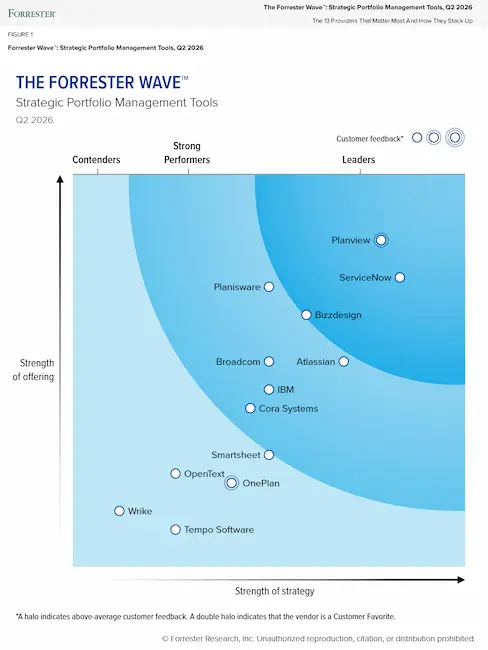
Forrester Wave Strategic Portfolio Management, Q1 2026

Strategic portfolio management (SPM) is essential as organizations work to balance growth and cost while navigating AI complexity, shifting business priorities, and rising demands for alignment between strategy and execution.

The Forrester Wave™: Strategic Portfolio Management Tools, Q2 2026 evaluates 13 market providers. The report shows how they stack up and helps buyers understand necessary capabilities and market trends shaping the SPM discipline.

Get complimentary access to the report to:

CAPTCHA

Why Is Bizzdesign Recognized as a Leader?

Bizzdesign was recognized as a Leader, with strategy, modeling, and capability-based planning noted as key differentiators. The report also notes that Bizzdesign best suits enterprises with complex planning needs and an emphasis on enterprise architecture.

The report noted:

  • Strategy: "AI investment is a significant part of [Bizzdesign’s] standout innovation."
  • Capabilities: "AI capabilities in portfolio management are intuitive and practical."
  • Customer feedback: "Customers cite Bizzdesign’s comprehensive planning and modeling capabilities as key standouts."

Why Do Organizations Choose Bizzdesign?

Bizzdesign is uniquely positioned at the intersection of strategic portfolio management (SPM) and enterprise architecture (EA), and is the only vendor recognized as a leader in the SPM Wave to also be named as a leader in The Forrester Wave™: Enterprise Architecture Management Suites, Q4 2024.

That matters because the market is shifting toward a unified transformation control plane. Forrester’s EA research points to a future where strategy, SPM, EA, and IT finance converge to prioritize and govern technology for business value in an AI-driven world. 

Bizzdesign is built for that shift, combining EA, SPM, and AI capabilities in one Enterprise Transformation Suite.


Forrester does not endorse any company, product, brand, or service included in its research publications and does not advise any person to select the products or services of any company or brand based on the ratings included in such publications. Information is based on the best available resources. Opinions reflect judgment at the time and are subject to change. This report is part of a broader collection of Forrester resources, including interactive models, frameworks, tools, data, and access to analyst guidance. For more information, read about Forrester’s objectivity here.

Confirmation | Webinar portefeuille applicatif et stratégie IT

Confirmation | Webinar portefeuille applicatif et stratégie IT

Merci pour votre inscription à notre webinar « Portefeuille applicatif & stratégie IT : comment Alfabet vous donne une longueur d'avance » du 28 mai 2026.

Vous recevrez prochainement par e-mail tous les détails pour participer à la session.

Pour toute question ou demande, vous pouvez contacter j.ferron@bizzdesign.com.