Bizzdesign Unify: An AI-native platform for faster, better transformation decisions.
From Enterprise Model to Decision Engine
From Enterprise Model to Decision Engine
A Practical Guide to Building a Digital Twin of Your Organization
What you'll learn in this guide
- How a Digital Twin of the Organization (DTO) connects strategic intent, enterprise design, and operational evidence to support continuously informed decisions.
- The five capability foundations required to build and run a DTO, and how to assess your organization's readiness across each one.
- The five-step lifecycle from design-time foundation to closed-loop improvement, with objectives, methods, outputs, readiness indicators, and common pitfalls for each step.
- How to start with one focused decision, outcome, or business problem and expand the DTO progressively as its value is demonstrated.

Bizzdesign Unify Assessment
Bizzdesign Unify Assessment
An independent analyst assessment across 16 enterprise architecture management criteria, with Bizzdesign Unify scoring 5/5 across all AI-related criteria.
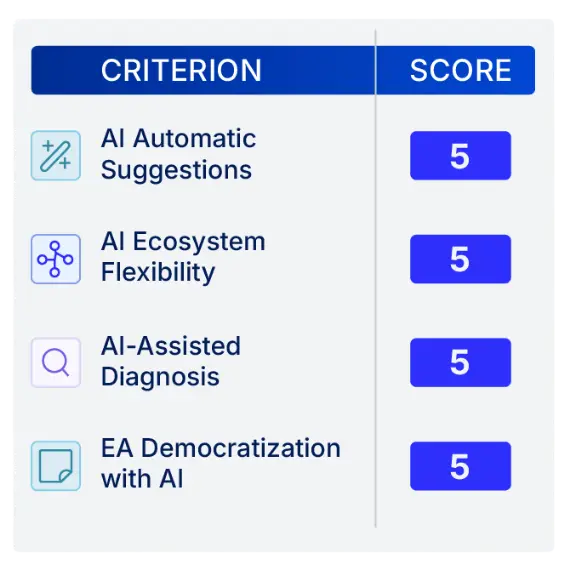
Former Forrester senior analyst Stéphane Vanrechem evaluated Bizzdesign Unify across a broad set of enterprise architecture management capabilities, examining what differentiates the platform, where it delivers the most value, and what buyers should consider as it continues to evolve.
Read the assessment to discover:
Organizations using Bizzdesign Unify







What Bizzdesign Unify users say
Bizzdesign Unify helps us move at pace while still keeping decisions grounded in real data.
Matthew Beech

Bizzdesign Unify helps non-technical stakeholders understand impacts and trade-offs easily, without going into architecture tools.
Partha Mukherjee

About the author
Stéphane Vanrechem is an enterprise architecture analyst and practitioner with more than 30 years of industry experience. During his time as a senior analyst at Forrester, he advised enterprise architecture professionals and researched enterprise architecture management, application portfolio management, technical debt, and sustainability. He also contributed to Forrester’s evaluation of enterprise architecture management suites. This independent assessment was authored by Stéphane Vanrechem, drawing on pilot-user feedback, as well as product demonstrations and supporting materials provided by Bizzdesign.
About Bizzdesign Unify
Bizzdesign Unify brings enterprise architecture context into the hands of business and technology teams, enabling faster, collaborative decision-making as AI accelerates change.
FAQs
Transformation rework often begins when teams make decisions without enough enterprise architecture context, discover dependencies too late, or lose the reasoning behind decisions as work moves into delivery. Bizzdesign Unify brings business goals, capabilities, applications, initiatives, and dependencies into shared Workspaces, helping business, architecture and delivery teams align earlier and carry context forward. Stéphane Vanrechem’s independent assessment of Bizzdesign Unify identifies potential benefits including a 30–40% reduction in alignment time, four to five weeks recovered during a 12-week mobilization, and a 25% reduction in transformation work.
Business and IT teams often work with different information, tools, and levels of detail. Business stakeholders rely on slides and workshops, while architects use modelling tools that many non-specialists cannot read. Bizzdesign Unify gives both groups a shared Workspace, where free-form ideas connect to structured enterprise information. The AI Co-worker responds to plain-language questions, helping business leaders explore architecture context without needing specialist modelling expertise. Stéphane Vanrechem’s assessment identifies the potential for a 30–40% reduction in alignment time.
Dependencies are often discovered late because the relevant information is spread across architecture repositories, portfolio tools, planning documents and different teams. Bizzdesign Unify brings enterprise architecture context into the earlier stages of transformation, including ideation, scenario analysis and option assessment, so teams can identify dependencies, risks and constraints before commitments are made. This supports earlier impact analysis and more informed transformation decisions.
Generic AI does not automatically understand how your organization works. It does not know how your goals, capabilities, applications and initiatives connect, what your constraints are, or what decisions have already been made. In Bizzdesign Unify, the AI Co-worker works with the enterprise context available within the Workspace, including published views, repository objects and the relationships between them. This helps teams ask questions, interpret diagrams and identify relevant dependencies, risks and constraints. Stéphane Vanrechem's independent assessment scored Bizzdesign Unify 5/5 across all four AI-related criteria.
Enterprise architecture and portfolio management tools provide structured enterprise data, while visual collaboration tools support workshops and ideation. Bizzdesign Unify connects these two areas by bringing relevant enterprise context into collaborative Workspaces. Through its integration capabilities, Bizzdesign Unify can connect with existing architecture repositories, portfolio platforms and operational systems, allowing those systems to remain authoritative sources while teams use their information in collaborative decision-making.
Cyera Just Paid $1 Billion to Answer the Question Most Companies Haven't Asked
Date
Image
Image

Industry Category
Language
Resource Category
Resource URL
https://www.linkedin.com/pulse/cyera-just-paid-1-billion-answer-question-most-havent-russ-fordyce--xvpqc/?trackingId=ozlFfyNESIS2%2B%2FrkMlq4mA%3D%3D
Squaring the circle - digital sovereignty’s big picture versus its operational details
Date
Image
Image

Industry Category
Language
Resource Category
Resource URL
https://diginomica.com/squaring-circle-digital-sovereigntys-big-picture-versus-its-operational-details
Building a NATO-Compliant Approach to Enterprise Architecture

Building a NATO-Compliant Approach to Enterprise Architecture
22.09.2026
10 am (BST)
Live Webinar
A common enterprise architecture approach with the NATO Architecture Framework (NAF) and ArchiMate
Defence organisations operate across complex national and multinational programmes, where a consistent approach to enterprise architecture can support interoperability, governance, and informed decision-making.
Join experts from the UK Ministry of Defence (MOD) and NATO Architecture Capability Team (ACaT) to gain:
Architecting Transformation At Scale with Nick Reed, Chief Strategy Officer at Bizzdesign
Date
Image
Image
Industry Category
Language
Resource Category
Resource URL
https://www.youtube.com/watch?v=njn93S83SOU&list=PLK-zrJbJ0LY8H6LEzalgLhAxesEjWBYu1&index=43
EU advances tech sovereignty and UK reshapes AI oversight
Date
Image
Image

Industry Category
Language
Resource Category
Resource URL
https://cfotech.co.uk/story/eu-advances-tech-sovereignty-and-uk-reshapes-ai-oversight
EU advances tech sovereignty and UK reshapes AI oversight
Date
Image
Image

Industry Category
Language
Resource Category
Resource URL
https://securitybrief.co.uk/story/eu-advances-tech-sovereignty-and-uk-reshapes-ai-oversight
EU advances tech sovereignty and UK reshapes AI oversight
Date
Image
Image

Industry Category
Language
Resource Category
Resource URL
https://itbrief.co.uk/story/eu-advances-tech-sovereignty-and-uk-reshapes-ai-oversight
Six Signs Your AI Portfolio Has Outgrown Informal Governance
Six Signs Your AI Portfolio Has Outgrown Informal Governance
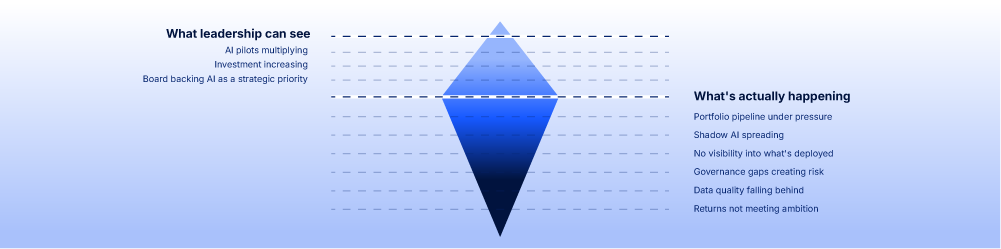
Most organizations can point to the AI initiatives they've formally approved. What's harder to account for is everything else. The tools adopted by individual teams, the capabilities embedded in applications through vendor updates, the workflows built by employees who didn't need IT's sign-off to get started. When the question of how much AI is running across the enterprise comes up, the honest answer is usually along the lines of: “More than we thought, and less governed than we'd like.”
A McKinsey study found that three times more employees are using generative AI for a third or more of their work than their leaders realize. What organizations don't know about their AI can create some of their greatest exposure, whether through regulatory non-compliance, data quality failures, ungoverned model dependencies, or investments that duplicate rather than compound.
That exposure tends to build over time. An AI portfolio has outgrown informal governance when teams can no longer reliably answer where AI is being used, who owns it, what risks it carries, or whether it's delivering value. At that point, isolated approvals aren't enough. Here are six signs it's happening.
1.
FAQs
The most consistent signals are an inability to answer foundational questions about the AI portfolio with confidence: what's in use, who approved it, what it's connected to, and whether it's delivering value. Organizations that have reached this point often find that different functions hold different versions of the AI inventory, that AI has entered through vendor updates or business-led tools without going through a formal process, and that AI investment decisions are being made without visibility into what already exists. If any of these sound familiar, informal governance has likely reached its limits.
Shadow AI refers to AI tools, features, and workflows being used across the organization without the knowledge or oversight of IT, EA, data, or risk functions. It typically spreads through no-code tools that allow employees to build their own workflows and access data independently without going through a formal approval process. The governance risk is the absence of any formal record of what's been deployed, who's accountable for it, what data it's processing, or how it connects to existing applications and business capabilities. What can't be seen can't be assessed for regulatory exposure, data quality risk, or strategic alignment. Bizzdesign Alfabet provides visibility into where AI is being used across the organization, including which applications are providing AI features and whether they've been formally approved.
Discovery tools that flag unauthorized network activity can play the same role for AI: identifying AI service usage across the organization so it can be registered in Bizzdesign Alfabet as an AI Technology object, mapped to a responsible owner, and brought under formal governance instead of operating as Shadow AI.
When AI is deployed without a formal record of what it does, what data it processes, and who approved it, organizations may struggle to demonstrate compliance when regulators ask. Under GDPR, for example, organizations need to understand and document how personal data is processed, for what purpose, and under what legal basis. If an employee uses an unapproved AI tool that processes customer data, the organization may create compliance exposure, even if there was no intent to bypass policy. Under the EU AI Act, which has been phasing in since 2024 with prohibited practices already enforceable and many transparency obligations taking effect in August 2026, certain AI applications require technical documentation, human oversight mechanisms, and formal risk assessments depending on how they are classified and used. Without a governed inventory of what AI is in use, organizations can't identify which systems fall under these requirements, let alone demonstrate they've met them.
AI governance is the broader set of policies, standards, roles, and oversight mechanisms that determine how AI is used, assessed, and controlled across the organization. AI portfolio management is what makes that governance operational. It provides the connected view of AI use cases, features, models, applications, and technologies that governance decisions depend on: what exists, who owns it, what it's connected to, and whether it's been formally approved. Without portfolio management, governance remains a policy document rather than a working system. Bizzdesign Alfabet brings both together, giving enterprise architecture and strategic portfolio management teams the portfolio visibility needed to govern AI consistently at enterprise scale.
The starting point is visibility, specifically understanding which applications across the enterprise are providing AI features, what those features do, and whether they've been formally assessed and approved. From there, organizations can document AI use cases, connect them to business capabilities and strategic priorities, inventory the models in use and the conditions under which they're permitted to operate, and establish the approval workflows that bring AI activity under consistent governance. Bizzdesign’s guide, AI Portfolio Governance in 7 Steps, walks through each of these steps in detail.
One common gap is the absence of a clear connection between AI initiatives and business outcomes. When AI use cases aren't linked to specific business capabilities, priorities, and success criteria from the outset, there's no baseline to measure performance against, no way to identify what's working, and no evidence base to justify continued investment. A governed AI portfolio addresses this by connecting every AI use case to a business capability, a defined investment rationale, and measurable value criteria, making it possible to track adoption, assess performance, and direct resources toward the initiatives with the clearest strategic case.