Conferma | Webinar Unify

Conferma | Webinar Unify

Grazie per esserti registrato al nostro webinar “Trasformazione e AI: decisioni informate con Bizzdesign Unify”.

Riceverai a breve via e-mail tutti i dettagli su come partecipare alla sessione. Per qualsiasi domanda o necessità, puoi contattare j.ferron@bizzdesign.com.

A presto,

Il team Bizzdesign


From AI-Assisted to AI-Native: Building Bizzdesign Unify for the Next Era of Enterprise Transformation

From AI-Assisted to AI-Native: Building Bizzdesign Unify for the Next Era of Enterprise Transformation

June 9, 2026 - Tom Jansen - AI in Enterprise Architecture & Transformation

Bizzdesign has spent more than 25 years in enterprise architecture, and in that time the work has always come back to the same thing: helping organizations find better ways of working and make complex decisions with greater confidence. So, when AI started to change what software could do, we saw a chance to rethink how enterprise transformation work happens.

That's why we built Bizzdesign Unify, a new platform within our Enterprise Transformation Suite. The first AI agents were just appearing as we began, and we designed for that reality from day one, so people, enterprise context, and AI agents could work together in real time rather than in separate tools.

This reflects a bigger change across enterprise software, and it's what I discussed with AWS at AWS Summit Amsterdam. Software has moved from traditional SaaS to AI-assisted tools, and now to AI-native platforms, where agents act as co-workers rather than features on the side. How much AI a platform has matters less than a simpler question. Does it help people make better decisions, faster?

Here's what we've learned about building AI-native enterprise transformation software, and how that thinking shaped Bizzdesign Unify.

What Being AI-Native Really Takes

The direction of travel here isn't really in doubt. Agentic AI is moving into enterprise software quickly, and the people building and buying that software can feel it. Gartner expects 40% of enterprise applications to include task-specific AI agents by the end of 2026, up from less than 5% in 2025.

FAQs

AI-assisted tools support a person doing the work, through features like search, suggestions, and answering questions. They respond when prompted and then stop. Agentic AI goes further: agents can pursue a goal, reason through steps, use tools, and take action across systems within defined boundaries, contributing as the work develops rather than waiting to be asked each time. In short, AI-assisted software helps a person produce, while agentic AI works alongside them to get things done.

AI-native software is built with AI as part of its core design, not added later as a feature. In an AI-native platform like Bizzdesign Unify, AI works with live enterprise context, tools, and people inside the same environment, rather than sitting on the side as a chatbot. That's the difference from AI-enabled software, which adds AI on top of a system that already exists. An AI-native product is designed around what AI makes possible from the start.

In enterprise transformation, being AI-native means AI agents work directly with an organization's live architecture and portfolio context, not with a generic model detached from how the business actually runs. That grounding is what makes the output trustworthy enough to act on. It also changes who can take part: when specialist context is available through natural-language interaction, more people across the organization can join transformation decisions, not only architects.

Bizzdesign Unify is an AI-native workspace for enterprise transformation, part of the Bizzdesign Enterprise Transformation Suite. It brings people, live enterprise context, visual collaboration, and AI co-workers into one shared workspace, so teams can explore ideas, model scenarios, and make decisions that stay grounded in their real architecture and portfolio data.

A chatbot sits to the side of your work and answers when asked. In Bizzdesign Unify, AI co-workers work inside the same canvas as the team, contributing as a plan takes shape. They can summarize a design, surface a risk, recommend an improvement, or take on repetitive analysis, and because they share the same live enterprise context the team is working from, what they produce is grounded in the organization's real architecture and portfolio data rather than a generic answer.

Because the model landscape changes constantly, an AI-native platform has to be built so it isn't tied to any one model. Bizzdesign Unify runs a configurable model stack on Amazon Bedrock, so models can be switched by changing configuration rather than rewriting code, and matched to different task types. New models can be tested and adopted as they appear, without rebuilding the platform, which means the value of the platform keeps improving as the underlying models do.


Transformation Collaboration: How Enterprise Leaders Are Turning AI Ambition into Execution

Transformation Collaboration: How Enterprise Leaders Are Turning AI Ambition into Execution

June 4, 2026 - Tonia Maneta - AI in Enterprise Architecture & Transformation

AI is changing how quickly organizations have to move, and how early the important decisions get made. Budgets, pilots, and direction are being set sooner than ever, often before teams share a clear view of what'll create value and what won't.  

At Bizzdesign Connect 2026, our cross-industry panel brought together five senior enterprise architecture leaders from KPMG, FMO (The Dutch Entrepreneurial Development Bank), IT Syntrix, VivaNova Consulting, and the Chief Architect Network, to talk through what AI is really demanding of enterprise transformation, and a common thread ran through the conversation.

The challenge is broader than AI itself. What matters is whether architecture, governance, and enterprise context are in the room early enough to shape decisions, while there's still room to move before strategic choices get expensive to reverse. That's the gap Transformation Collaboration is built to close.

Here's what the panel told us. 

Why AI Investment Needs Enterprise Clarity First

Leonardo Vivas, Founder of VivaNova Consulting and formerly Senior Director of the enterprise acceleration office at Target, opened with an observation that set the tone for the rest of the discussion: too many organizations measure AI progress by how many licenses they've deployed or how many pilots are running, rather than asking which business capabilities have the highest value and what's driving underperformance in them.

FAQs

Transformation Collaboration is Bizzdesign’s solution for bringing visual collaboration, enterprise context, and AI-driven insight together during enterprise change. It is delivered through Bizzdesign Unify, Bizzdesign’s new SaaS product within the Enterprise Transformation Suite.

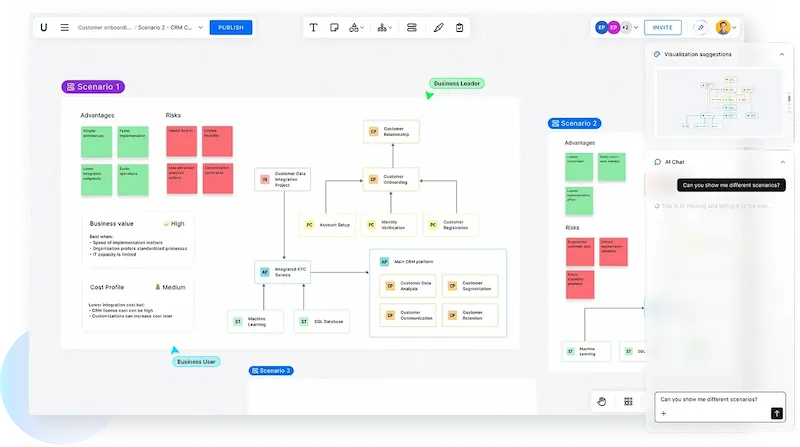
Transformation Collaboration is designed to bring people, plans, enterprise intelligence, and AI-driven insights together while decisions are still taking shape. In practice, that means teams can work from the same enterprise picture earlier, assess trade-offs with more context, and carry decisions forward with less rework. In Bizzdesign Unify, Transformation Collaboration takes shape through three connected use cases: Collaborative Ideation, Scenario Analysis, and Initiative Mobilization. 

Bizzdesign Unify is the collaborative layer of the Bizzdesign Enterprise Transformation Suite. It gives cross-functional teams, including business leaders, architects, strategy, and delivery teams, a shared workspace to explore ideas, model scenarios, and align on initiatives, all connected to live enterprise architecture data.

Where tools like Miro or Mural support ideation and collaboration, Bizzdesign Unify adds the enterprise context those tools aren’t designed to provide dependencies, constraints, and structured data from architecture, portfolio, and system-of-record sources your organization already maintains. Teams work in a familiar canvas environment without needing deep technical expertise. The enterprise context surfaces in the flow of work. Decisions made in collaborative sessions hold up in execution because the trade-offs were visible when the decisions were being made.

Pilot purgatory is the pattern where an AI initiative delivers results in one context but can’t be scaled because the underlying data models and logic were built for that specific context rather than designed to travel. When scope expands, teams rebuild rather than scale, and the learning stays local. Enterprise architecture addresses this by making the implicit explicit: codifying the organizational reasoning, data structures, and decision logic that currently exist in processes and institutional knowledge, so AI solutions can operate consistently across business units and contexts. Distinguishing what is generic across the organization from what is specific to a given context is the foundational work that separates AI projects that scale from those that stall.

Enterprise architecture enables AI governance by maintaining the traceability chain that connects AI systems to the controls and oversight structures governing them. This chain runs from business applications to AI agents, from agents to the models they use, from models to the platforms hosting them, and from platforms to the approved controls and guardrails in place.

As AI adoption accelerates and new models are released faster than traditional governance cycles can absorb, this traceability becomes the foundation for governance, risk management, and audit. Without it, organizations can’t demonstrate active oversight of their AI systems, which is increasingly required under frameworks such as the EU AI Act. Enterprise architecture teams that maintain this chain as a live capability, rather than periodic documentation, are the ones best positioned to enable AI innovation without creating governance gaps.

Enterprise architects identify where AI will create the most business value by applying capability decomposition: mapping the highest-value business capabilities, identifying the root causes of underperformance in them, and then assessing whether AI is the right solution to those root causes.

This approach avoids the common failure mode of measuring AI progress by license counts or use case volume, which can show activity without proving value. When organizations skip capability decomposition and move directly into experimentation, they generate AI investment that is difficult to govern, scale, or connect to business outcomes. When they apply it, they produce proof points that both senior executives and engineering teams can act on, as well as a clear definition of what success looks like before commitment is made.

Enterprise transformation typically stalls between strategy and execution because the decisions that shape an initiative's success are made before the enterprise intelligence needed to validate them is present. Workshops and strategy sessions happen in collaborative tools; architecture data lives in separate platforms consulted at a different stage. By the time architecture is involved, investment has been committed and direction set. The dependencies, constraints, and risks that would have changed the decision surface later, when the cost of changing course is higher.

Closing this gap requires bringing enterprise architecture data into the collaborative sessions where transformation decisions are being made, not as a review step after the fact. This is the core design principle behind Bizzdesign’s solution Transformation Collaboration.


Transformation Collaboration

Transformation Collaboration

Missing the full picture? Unify your workspace with Transformation Collaboration

Align Teams Around a Shared Enterprise View

Teams brainstorm in visual tools and manage context in enterprise architecture platforms, but the two rarely connect. Workshop ideas go unvalidated, architecture stays siloed, and decisions aren’t grounded in reality just as AI accelerates change. Transformation Collaboration bridges this gap with a shared workspace that brings trusted architecture data into collaborative sessions to reduce late discovery, misalignment, and rework in transformation initiatives. 

Align Early. Decide Together. Transform Faster.

  • Ideate visually while grounding ideas in enterprise reality from the start.
  • Evaluate options faster with AI-powered scenario analysis and shared enterprise intelligence. 
  • Turn whiteboard collaboration into actionable plans without delays or rework. 
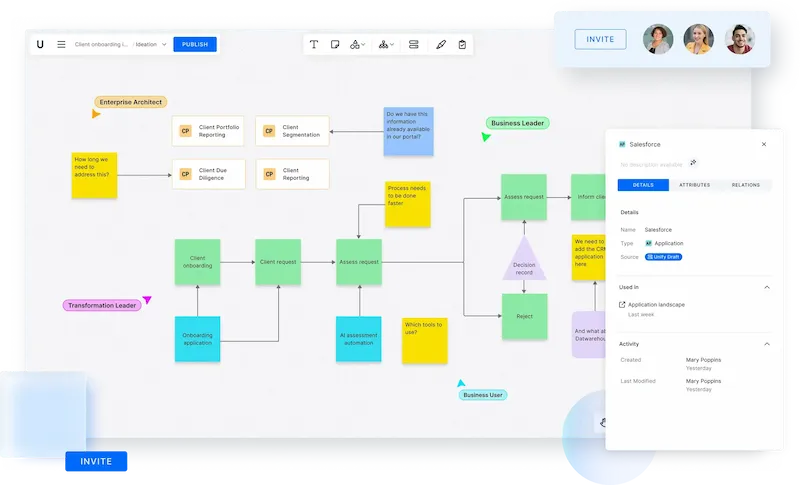
Collaborative Ideation

Collaborative Ideation

Co-Create with Context

  • Drag, sketch, or map ideas and link them directly to capabilities, processes, and systems. 
  • Ground workshops in architecture data and reality before committing resources.
  • Surface dependencies, constraints, and risks in real time as concepts evolve.
Scenario Analysis

Scenario Analysis

Align on the Best Path Forward

  • Empower every team to model what-if scenarios through simple, natural language interactions.
  • Assess impact across business and technology using live architecture data and AI generated insights.
  • Compare options with shared context on performance, maturity, and technical fit to speed decision making.
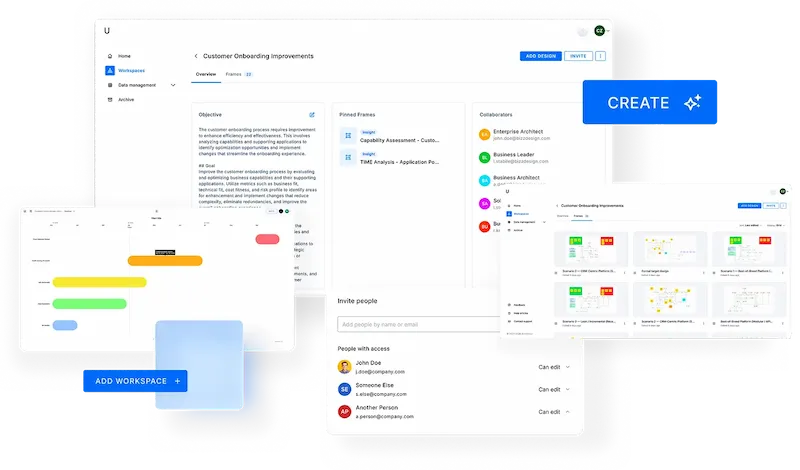
Initiative Mobilization

Initiative Mobilization

Start Strong from Day One

  • Launch initiatives seamlessly with pre-populated workspaces and insights. 

  • Formalize workshop whiteboards into structured, traceable artifacts ready for execution.

  • Define scope confidently using governed architecture data and impact analysis.

 
Move Transformation Forward, Together.

Connect teams, decisions, and enterprise context to reduce misalignment and accelerate execution.