
Bizzdesign Unify: An AI-native platform for faster, better transformation decisions.
Confirmation | The AI-era CIO: Turning enterprise context into decision intelligence and value
Confirmation | The AI-era CIO: Turning enterprise context into decision intelligence and value
You have successfully registered for the webinar on 29 September and will receive a confirmation email shortly with event access details. Contact us at marketing@bizzdesign.com if you have any questions.
Thank you!
Do You Have Shadow AI in Your Organization?

Do You Have Shadow AI in Your Organization?
Thursday - 3rd September 2026
9:30AM SGT / 11:30AM AEST
Webinar
Everyone is investing in AI. But amid the excitement, two critical questions are emerging: Are we building real business value or simply chasing AI hype? And as AI adoption accelerates, do we actually know where AI agents are being created, deployed, and making decisions across the organization?
What Really Changes in the ArchiMate® 4 Specification and What Does Not
What Really Changes in the ArchiMate® 4 Specification and What Does Not
TL;DR:
Marc Lankhorst, Managing Consultant & Chief Technology Evangelist at Bizzdesign, has managed the development of the ArchiMate modeling language since its inception more than 20 years ago. Here, he explains what the language’s first major update in a decade changes, what remains familiar, and why the ArchiMate® 4 Specification matters for practitioners.



Fresh perspectives on the future of enterprise architecture
Fresh perspectives on the future of enterprise architecture
TL;DR
Enterprise architecture is evolving as people from broader backgrounds enter the profession, transformation becomes more multidisciplinary, and AI makes architecture knowledge faster and easier to surface. Emerging and experienced architects contribute different strengths, while trusted enterprise context helps transformation teams and AI apply that knowledge effectively.
Related Articles



Independent assessment gives Bizzdesign Unify top scores for AI
Independent assessment gives Bizzdesign Unify top scores for AI
August 10, 2026
Enschede, Netherlands – Bizzdesign Unify, an AI-native enterprise transformation intelligence platform, received the highest possible score across six of 16 foundational enterprise architecture management (EAM) platform criteria in an independent assessment.&
About Bizzdesign
Bizzdesign is a global enterprise transformation SaaS company, offering an end-to-end suite spanning Enterprise Architecture, Strategic Portfolio Management, Governance, Risk & Compliance, and Transformation Collaboration. Through a data-driven and AI-powered approach, Bizzdesign accelerates transformation from vision to value by enabling teams to plan, design and govern change collaboratively.
FAQs
As AI accelerates the pace of planning and decision-making, organizations need a shared view of their own operating environment. Bizzdesign Unify combines visual collaboration with enterprise context, enabling cross-functional teams to explore options, understand impacts and align on decisions without requiring specialist enterprise architecture expertise.
Organizations can reduce downstream surprises by assessing scenarios against actual enterprise context while decisions are still taking shape. Bizzdesign Unify brings connected enterprise data into a shared visual workspace, helping teams surface dependencies, risks and constraints earlier, make better-informed decisions, and avoid rework.
Bizzdesign Unify Assessment
Bizzdesign Unify Assessment
An independent analyst assessment across 16 enterprise architecture management criteria, with Bizzdesign Unify scoring 5/5 across all AI-related criteria.
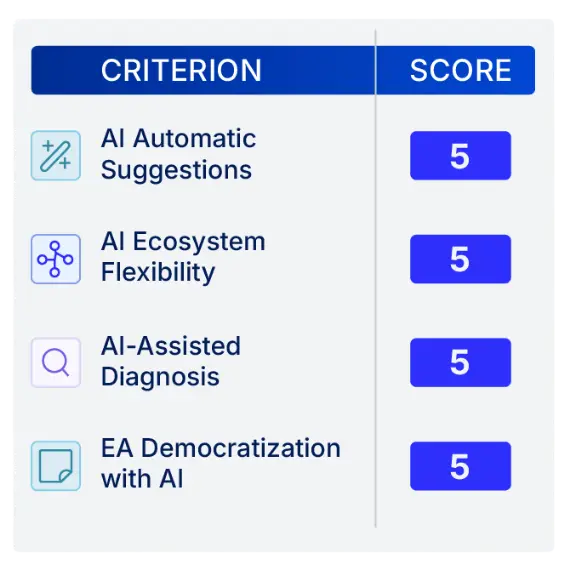
Former Forrester senior analyst Stéphane Vanrechem evaluated Bizzdesign Unify across a broad set of enterprise architecture management capabilities, examining what differentiates the platform, where it delivers the most value, and what buyers should consider as it continues to evolve.
Read the assessment to discover:
Organizations using Bizzdesign Unify







What Bizzdesign Unify users say
Bizzdesign Unify helps us move at pace while still keeping decisions grounded in real data.
Matthew Beech

Bizzdesign Unify helps non-technical stakeholders understand impacts and trade-offs easily, without going into architecture tools.
Partha Mukherjee

About the author
Stéphane Vanrechem is an enterprise architecture analyst and practitioner with more than 30 years of industry experience. During his time as a senior analyst at Forrester, he advised enterprise architecture professionals and researched enterprise architecture management, application portfolio management, technical debt, and sustainability. He also contributed to Forrester’s evaluation of enterprise architecture management suites. This independent assessment was authored by Stéphane Vanrechem, drawing on pilot-user feedback, as well as product demonstrations and supporting materials provided by Bizzdesign.
About Bizzdesign Unify
Bizzdesign Unify brings enterprise architecture context into the hands of business and technology teams, enabling faster, collaborative decision-making as AI accelerates change.
FAQs
Transformation rework often begins when teams make decisions without enough enterprise architecture context, discover dependencies too late, or lose the reasoning behind decisions as work moves into delivery. Bizzdesign Unify brings business goals, capabilities, applications, initiatives, and dependencies into shared Workspaces, helping business, architecture and delivery teams align earlier and carry context forward. Stéphane Vanrechem’s independent assessment of Bizzdesign Unify identifies potential benefits including a 30–40% reduction in alignment time, four to five weeks recovered during a 12-week mobilization, and a 25% reduction in transformation work.
Business and IT teams often work with different information, tools, and levels of detail. Business stakeholders rely on slides and workshops, while architects use modelling tools that many non-specialists cannot read. Bizzdesign Unify gives both groups a shared Workspace, where free-form ideas connect to structured enterprise information. The AI Co-worker responds to plain-language questions, helping business leaders explore architecture context without needing specialist modelling expertise. Stéphane Vanrechem’s assessment identifies the potential for a 30–40% reduction in alignment time.
Dependencies are often discovered late because the relevant information is spread across architecture repositories, portfolio tools, planning documents and different teams. Bizzdesign Unify brings enterprise architecture context into the earlier stages of transformation, including ideation, scenario analysis and option assessment, so teams can identify dependencies, risks and constraints before commitments are made. This supports earlier impact analysis and more informed transformation decisions.
Generic AI does not automatically understand how your organization works. It does not know how your goals, capabilities, applications and initiatives connect, what your constraints are, or what decisions have already been made. In Bizzdesign Unify, the AI Co-worker works with the enterprise context available within the Workspace, including published views, repository objects and the relationships between them. This helps teams ask questions, interpret diagrams and identify relevant dependencies, risks and constraints. Stéphane Vanrechem's independent assessment scored Bizzdesign Unify 5/5 across all four AI-related criteria.
Enterprise architecture and portfolio management tools provide structured enterprise data, while visual collaboration tools support workshops and ideation. Bizzdesign Unify connects these two areas by bringing relevant enterprise context into collaborative Workspaces. Through its integration capabilities, Bizzdesign Unify can connect with existing architecture repositories, portfolio platforms and operational systems, allowing those systems to remain authoritative sources while teams use their information in collaborative decision-making.
Confirmation | Bizzdesign Unify Assessment
Confirmation | Bizzdesign Unify Assessment
Your Download Is Ready –– Enjoy the Insights!
Confirmación | Bizzdesign Circle Event - Santo Domingo
Confirmación | Bizzdesign Circle Event - Santo Domingo
Gracias por registrarte en nuestro evento Bizzdesign Circle Event en Santo Domingo. ¡Tu registro ha sido confirmado!
Próximamente recibirás un correo con todos los detalles para unirte al evento.
Nos vemos en Republica Dominicana,
El equipo de Bizzdesign
Bizzdesign Circle Event | Santo Domingo

Bizzdesign Circle Event | Santo Domingo
22 de septiembre del 2026
9:00AM (Hora local)
JW Marriot Hotel Santo Domingo
Avenida Winston Churchill, Santo Domingo, Distrito Nacional
Qué esperar
En un evento Bizzdesign Circle, explorarás cómo las organizaciones están:
- Acelerando la madurez de Enterprise Architecture (EA) para apoyar mejor las prioridades estratégicas
- Superando desafíos comunes de cambio y ejecución
- Generando impacto medible en el negocio a través de una mejor alineación
El evento incluye:
Confirmation | Bizzdesign Connect North America 2026
Confirmation | Bizzdesign Connect North America 2026
You’ve stepped into the Intelligent Transformation Revolution. You will receive a confirmation email shortly with event access details.
Contact us with any questions.