Six Signs Your AI Portfolio Has Outgrown Informal Governance

Six Signs Your AI Portfolio Has Outgrown Informal Governance

July 22, 2026 - Ali Rizvi - Application and Technology Management

Most organizations can point to the AI initiatives they've formally approved. What's harder to account for is everything else. The tools adopted by individual teams, the capabilities embedded in applications through vendor updates, the workflows built by employees who didn't need IT's sign-off to get started. When the question of how much AI is running across the enterprise comes up, the honest answer is usually along the lines of: “More than we thought, and less governed than we'd like.”

A McKinsey study found that three times more employees are using generative AI for a third or more of their work than their leaders realize. What organizations don't know about their AI can create some of their greatest exposure, whether through regulatory non-compliance, data quality failures, ungoverned model dependencies, or investments that duplicate rather than compound.

That exposure tends to build over time. An AI portfolio has outgrown informal governance when teams can no longer reliably answer where AI is being used, who owns it, what risks it carries, or whether it's delivering value. At that point, isolated approvals aren't enough. Here are six signs it's happening.
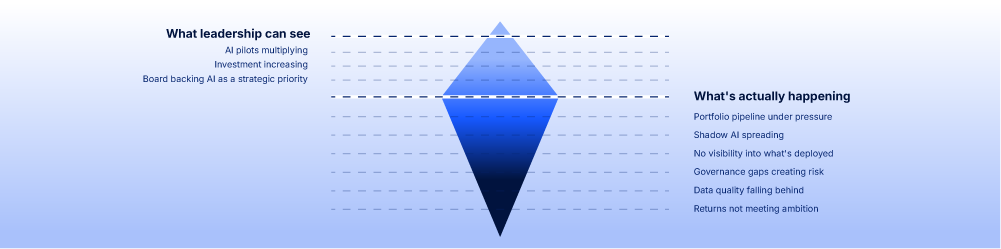
An iceberg diagram illustrating the gap between what leadership sees in enterprise AI adoption, pilots multiplying and investment increasing, and the six governance problems beneath the surface: an overwhelmed portfolio pipeline, spreading shadow AI, lack of deployment visibility, governance gaps, unreliable data, and uncertain returns.

1.

FAQs

The most consistent signals are an inability to answer foundational questions about the AI portfolio with confidence: what's in use, who approved it, what it's connected to, and whether it's delivering value. Organizations that have reached this point often find that different functions hold different versions of the AI inventory, that AI has entered through vendor updates or business-led tools without going through a formal process, and that AI investment decisions are being made without visibility into what already exists. If any of these sound familiar, informal governance has likely reached its limits.

Shadow AI refers to AI tools, features, and workflows being used across the organization without the knowledge or oversight of IT, EA, data, or risk functions. It typically spreads through no-code tools that allow employees to build their own workflows and access data independently without going through a formal approval process. The governance risk is the absence of any formal record of what's been deployed, who's accountable for it, what data it's processing, or how it connects to existing applications and business capabilities. What can't be seen can't be assessed for regulatory exposure, data quality risk, or strategic alignment. Bizzdesign Alfabet provides visibility into where AI is being used across the organization, including which applications are providing AI features and whether they've been formally approved.

Discovery tools that flag unauthorized network activity can play the same role for AI: identifying AI service usage across the organization so it can be registered in Bizzdesign Alfabet as an AI Technology object, mapped to a responsible owner, and brought under formal governance instead of operating as Shadow AI.

When AI is deployed without a formal record of what it does, what data it processes, and who approved it, organizations may struggle to demonstrate compliance when regulators ask. Under GDPR, for example, organizations need to understand and document how personal data is processed, for what purpose, and under what legal basis. If an employee uses an unapproved AI tool that processes customer data, the organization may create compliance exposure, even if there was no intent to bypass policy. Under the EU AI Act, which has been phasing in since 2024 with prohibited practices already enforceable and many transparency obligations taking effect in August 2026, certain AI applications require technical documentation, human oversight mechanisms, and formal risk assessments depending on how they are classified and used. Without a governed inventory of what AI is in use, organizations can't identify which systems fall under these requirements, let alone demonstrate they've met them.

AI governance is the broader set of policies, standards, roles, and oversight mechanisms that determine how AI is used, assessed, and controlled across the organization. AI portfolio management is what makes that governance operational. It provides the connected view of AI use cases, features, models, applications, and technologies that governance decisions depend on: what exists, who owns it, what it's connected to, and whether it's been formally approved. Without portfolio management, governance remains a policy document rather than a working system. Bizzdesign Alfabet brings both together, giving enterprise architecture and strategic portfolio management teams the portfolio visibility needed to govern AI consistently at enterprise scale.

The starting point is visibility, specifically understanding which applications across the enterprise are providing AI features, what those features do, and whether they've been formally assessed and approved. From there, organizations can document AI use cases, connect them to business capabilities and strategic priorities, inventory the models in use and the conditions under which they're permitted to operate, and establish the approval workflows that bring AI activity under consistent governance. Bizzdesign’s guide, AI Portfolio Governance in 7 Steps, walks through each of these steps in detail.

One common gap is the absence of a clear connection between AI initiatives and business outcomes. When AI use cases aren't linked to specific business capabilities, priorities, and success criteria from the outset, there's no baseline to measure performance against, no way to identify what's working, and no evidence base to justify continued investment. A governed AI portfolio addresses this by connecting every AI use case to a business capability, a defined investment rationale, and measurable value criteria, making it possible to track adoption, assess performance, and direct resources toward the initiatives with the clearest strategic case.


 

Bizzdesign Connect North America 2026

Bizzdesign Connect North America

September 17, 2026

9:30AM CDT / 10:30AM EDT 

Virtual Event

Register Now!
See the agenda
Info-Tech Research Group
Chief Architect Network

Where AI Meets the Moment of Decision

Enterprise Architecture is becoming more strategic, more intelligent, and more central to how organizations operate. The question is whether yours is keeping pace.

By the time enterprise context enters the conversation, the window to influence direction has already closed. Priorities are locked in. Investments have moved. Risks are no longer hypothetical.

What are the biggest challenges to achieving ROI from AI?

Discover 4 Steps to Improve AI ROI and Governance.

Bizzdesign Circle Den Haag

Bizzdesign Circle Den Haag

01.10.2026

13:00 - 17:00

Tweede Kamer der Staten-Generaal

Bezuidenhoutseweg 67
2594 AC Den Haag

Evenement ter plaatse

Meld u hier aan!
See the agenda
Tweede Kamer

Wat u kunt verwachten

De Bizzdesign Circle is een kleinschalige bijeenkomst voor enterprise architecten uit de publieke sector die verantwoordelijk zijn voor digitale transformatie en enterprise architectuur.

In een open en interactieve setting bespreken deelnemers actuele uitdagingen, delen we praktijkervaringen en verkennen we verschillende perspectieven.

Schrijf u vandaag nog in. Meer informatie over het programma en de sprekers volgt binnenkort.

Meld u hier aan!

AI Portfolio Governance in 7 Steps

AI Portfolio Governance in 7 Steps

A Practical Guide for Enterprise Architecture and Strategic Portfolio Management Teams

Summary

What you'll learn in this guide: 

  • Why governing AI requires a different approach from managing a conventional application portfolio, and what that means in practice. 
  • How to structure an AI portfolio so that every use case, feature, model, and technology is visible, accountable, and traceable from business intent down to the technology stack. 
  • Who needs to be involved and what each role is responsible for. 
  • A seven-step process for bringing the AI portfolio under governance, from the first application assessment through to a complete, connected view of the full AI architecture. 
  • What a governed portfolio makes possible: responsible AI practices, better risk and investment decisions, and the ability to direct resources toward the initiatives that matter most.


AI has entered the enterprise faster than the organizational discipline to manage it has developed. Business units adopt AI through embedded functionality, decentralized experimentation, and business-led tools, often outside any formal approval process. The result is an AI landscape that's difficult to see clearly and harder still to govern.
Without a shared framework to track and govern it, fundamental questions become difficult to answer: What AI do we have? Who approved it? Where is it permitted to operate? What business priority does it support? And is it working?

FAQs

Start with your application portfolio. Flag all applications that are providing AI features, then document the AI features each one delivers, the models powering them, and the technologies those models rely on. This four-layer structure, covering AI use cases, AI features, AI models, and AI technologies, gives you a complete and traceable picture of AI across the enterprise. Tools like Bizzdesign Alfabet are built specifically to capture and govern this structure, giving organizations a single source of truth for AI usage across the business.

The goals are the same: align investments to business strategy, reduce risk, and keep costs in check. What's different is the entity being governed. An application is a discrete, definable object with a clear owner and a known user base. AI manifests across the organization in multiple forms simultaneously, at the level of the business use case, the feature that delivers it, the model that powers it, and the underlying technology. Each layer needs to be documented and governed separately, which is why AI portfolio management requires its own structure.

Enterprise architecture defines how an organization's strategy, processes, data, and technology fit together. In the context of AI governance, EA plays three critical roles: it connects AI use cases to business capabilities and portfolio priorities, it establishes the architectural framework and standards for AI adoption, and it ensures traceability from AI use cases all the way down to the underlying technology stack. Without EA, AI governance lacks the structural foundation to be consistent or defensible.

Effective AI governance requires five connected roles. The Application Owner flags AI-enabled applications and defines their AI-driven features. The Technology Architect identifies the technologies behind AI models and categorizes what's in use. The CTO and AI Competency Center ensure adoption stays aligned with business goals. The Enterprise Architect designs the governance framework and sets standards. The Risk and Compliance Manager ensures regulatory compliance across the portfolio. None of these roles works well in isolation, and all five need a shared view of the portfolio to function as a governance system. Bizzdesign Alfabet provides that shared view, with predefined business questions and executive-ready reporting built in.

If you can't answer basic questions about your AI with confidence, you need one. Specifically: Can you produce a complete list of AI running across the enterprise? Do you know which use cases have been formally approved and by whom? Can you trace any AI feature back to the model powering it and the technology beneath that? Can you show which business priority each use case supports and whether it warrants continued investment? If those questions require significant effort to answer, or produce different answers depending on who you ask, the portfolio isn't under governance.

Shadow AI refers to AI tools and workflows being used across the organization without the knowledge or oversight of IT, EA, or risk functions. It typically spreads through embedded AI features, independently acquired tools and business-led experimentation outside formal technology and approval processes. Getting it under control requires enterprise-wide standards that define how AI can be used, by whom, and within what boundaries, combined with a connected view of what's been deployed across the application landscape. Bizzdesign Alfabet supports this by tracking AI-specific attributes across applications and components, making it possible to identify ungoverned AI and bring it into the portfolio.

Building a governed AI portfolio follows seven steps, each one adding a layer of visibility and structure. Start by flagging all applications providing AI features, then document the AI features each one delivers and assess their risk levels. Map those features to their providing applications, then document the AI use cases they support and define the approval process. Create an inventory of approved AI models by location and jurisdiction, map those models to the features and components they power, and finally define the AI technologies being provided by those models. Each step builds on the last, moving from application-level visibility through to a complete, traceable picture of the full AI architecture. Bizzdesign Alfabet's AI Portfolio Management Accelerator is designed to support this process, with preconfigured structures and views that make each step faster to execute and easier to maintain.


What Enterprise Leaders Are Missing: Portfolio Visibility for Strategic Decisions

What Enterprise Leaders Are Missing: Portfolio Visibility for Strategic Decisions

May 28, 2026 - Conrad Langhammer - Portfolio and Capability Planning

Enterprise transformations usually have ambition and a strategy. Fewer have the visibility needed to to make decisions against them. 

Most leaders recognize the pattern. The investment intent is there. But when the moment arrives to act on strategy, to fund the capabilities that will deliver it and make the portfolio trade-offs that funding requires, the necessary visibility often isn't.

That's the visibility gap: the distance between the decisions enterprise leaders need to make and the portfolio insight available when those decisions are made. And understanding where that gap comes from matters, because it shapes how you address it.

Every merger, regulatory change, and new initiative adds to the portfolio. Geopolitical instability, economic shifts, and rapid technology change compound this further, forcing leaders to revisit priorities more often and act under tighter time pressure. Rationalization requires sustained effort and budget, both of which are easily crowded out by competing priorities. Systems stay in production, dependencies accumulate, and over time, what nobody planned becomes the landscape everyone has to navigate.

Financial pressure sharpens the problem. According to Gartner's 2026 CIO and Technology Executive Survey, 57% of CIOs face pressure to improve productivity and 52% face pressure to reduce costs simultaneously. Without a coherent view across applications and technologies, that pressure has nowhere productive to land: leaders can't identify where to cut without risking operational stability, or where to invest without duplicating what already exists.

Most of the leaders we work with aren't short on strategic vision. They're operating with an incomplete picture of their own landscape. What they may not yet fully see is how much harder that gap has become to absorb.

"The strategy exists. The investment intent is there. But when critical decisions arise, the visibility to act on them often isn't."

Why Incomplete Portfolio Visibility Is Getting More Expensive to Ignore

The visibility gap has always existed in enterprise IT. What's changed is that three forces, each familiar on its own, are now converging in ways that make the cost of incomplete visibility much harder to absorb.

FAQs

The enterprise technology visibility gap is the difference between what leaders intend strategically and what the organization can actually see, assess, and act on across its application and technology portfolio. It develops when portfolios expand faster than they're rationalized, legacy systems accumulate without documented costs and dependencies, and architectural complexity builds through individually pragmatic decisions over time. The result is that trade-offs can't be evaluated clearly, investment decisions rest on assumptions, and organizations default to managing change reactively. It's not a planning failure or a talent gap. It's a structural condition that builds through years of rational decisions made under real constraints.

AI projects and initiatives create dependencies across the existing enterprise landscape: the data they draw from, the systems they touch, the investments they may duplicate or displace. When organizations commit significant budget to AI before they have a reliable view of that landscape, governance is reactive by default and course-correcting later costs significantly more. BCG's research found that more than 55% of companies fail to manage the full portfolio of tech projects, including the interdependencies within and across programs. That pattern is especially costly for AI, where the pace of investment is outrunning the portfolio insight needed to govern it well.

Bizzdesign Alfabet is the platform within the Bizzdesign Enterprise Transformation Suite that enables Application Portfolio Management, Technology Portfolio Management, and Strategic Portfolio Management in one connected view. It gives organizations a governed, maintained view of what applications and technologies exist across the enterprise, what they cost, who owns them, what they support, and where the dependencies and lifecycle risks lie. That foundation connects directly to strategic planning and investment decisions, helping leaders evaluate trade-offs, prioritize modernization, manage risk, and sequence transformation based on what's feasible as well as what's strategically important. Additionally, Bizzdesign Alfabet is recognized as a Leader in The Forrester Wave™: Strategic Portfolio Management Tools, Q2 2026.

Application Portfolio Management focuses on inventorying, assessing, and governing applications to align the application landscape with business strategy and architectural standards. It addresses visibility into application ownership, lifecycle, cost, business fit, and technical health. Technology Portfolio Management focuses on the technologies that support those applications: standards, versions, lifecycle risk, vendor exposure, and dependencies. It addresses technology sprawl, version fragmentation, standards enforcement, and end-of-support risk.

Together they provide the foundation Strategic Portfolio Management requires. Bizzdesign Alfabet brings Application Portfolio Management, Technology Portfolio Management, and Strategic Portfolio Management together in one connected view, so the foundation that strategic planning depends on is continuously maintained rather than periodically assembled.

Strategic Portfolio Management supports AI governance and investment decisions by making the application and technology landscape that AI initiatives depend on visible before commitments are made. Each AI initiative creates dependencies across the existing portfolio: the data it can access, the systems it touches, the risks it introduces, and the investments it may displace or require.  

Without portfolio visibility, AI planning becomes speculative and governance becomes reactive. With Strategic Portfolio Management in place, organizations can evaluate AI opportunities against enterprise priorities, architecture constraints, data and technology dependencies, lifecycle risk, and security exposure. Bizzdesign Alfabet supports this with capabilities including AI portfolio management, strategic investment planning, and portfolio-wide analysis across applications, technologies, and dependencies.


2025 Gartner® Critical Capabilities for Enterprise Architecture Tools

2025 Gartner® Critical Capabilities for Enterprise Architecture Tools

Gartner®  Report
See how Bizzdesign is represented in Gartner’s assessment of enterprise architecture tool capabilities

2025 Gartner Critical Capabilities for Enterprise Architecture Tools

Enterprise architecture tools enable organizations to envision, model, and plan their future across evolving business, operating, and technology models. As transformation grows more complex and AI becomes a key capability, this report evaluates vendors across five key enterprise architecture use cases to reflect what buyers need to align strategy, execution, and outcomes.

Access the report

CAPTCHA

What we believe sets Bizzdesign apart

This report provides a comprehensive evaluation of enterprise architecture tools, analyzing vendor performance across five critical use cases and highlighting strengths in strategy alignment, governance, and solution architecture delivery. It delivers insights into vendor positioning, product differentiation, and AI-driven capabilities, helping enterprise architecture teams select platforms that support transformation and better align strategy, execution, and business outcomes.

In our opinion, the report reflects the breadth of Bizzdesign’s offering, with three Bizzdesign products assessed across all five Gartner enterprise architecture use cases. In addition, Bizzdesign ranked among the three highest vendors for Bizzdesign (Horizzon) in every use-case evaluation, including #1 for Solution Architecture Design and Delivery.


Gartner®, Critical Capabilities for Enterprise Architecture Tools, By Andrei Razvan Sachelarescu, Austin Steinmetz, Fred Ganter, Andrew Gianni, 7 October 2025. Gartner is a trademark of Gartner, Inc. and/or its affiliates.

Gartner does not endorse any vendor, product or service depicted in its research publications and does not advise technology users to select only those vendors with the highest ratings or other designation. Gartner research publications consist of the opinions of Gartner’s research organization and should not be construed as statements of fact. Gartner disclaims all warranties, expressed or implied, with respect to this research, including any warranties of merchantability or fitness for a particular purpose.

Government IT Leaders Can't Govern Cost, Cybersecurity, or AI Without Portfolio Visibility

Government IT Leaders Can't Govern Cost, Cybersecurity, or AI Without Portfolio Visibility

April 30, 2026 - Brian George - Application and Technology Management

How many systems or applications does your agency operate? How many are redundant? Which ones are unused? Which ones touch Personally Identifiable Information (PII)? If you can't answer those questions in real time, you're not alone; but you're also not prepared for what's coming.

Government departments and agencies are under pressure to modernize faster while controlling costs, strengthening cybersecurity, and governing emerging technologies such as artificial intelligence (AI).

For government IT leaders, these expectations translate into overlapping demands: annual portfolio reviews required under the Federal Information Technology Acquisition Reform Act (FITARA), ongoing modernization and cloud transformation, tightening cybersecurity oversight, and fast-rising expectations for AI governance and transparency.

Translating those mandates into operational outcomes requires a reliable and continuously updated view of the application portfolio so leaders understand which systems exist, what they cost, which mission services they support, and how they interconnect.

In practice, however, that visibility is often assembled piecemeal or in response to an impending event. Application inventories and portfolio information are frequently reconstructed only when oversight cycles require it, for example during audit preparation, budget submissions, or major modernization initiatives. Even the governance processes intended to maintain portfolio visibility can prove difficult to sustain. The Government Accountability Office's November 2024 (GAO) assessment, for example, found that many agencies have not consistently met FITARA's statutory requirement to conduct even annual IT portfolio reviews.

As modernization programs accelerate, cybersecurity obligations tighten, and agencies expand the use of AI systems, these fragmented and episodic portfolio practices create growing operational constraints. Leaders are expected to make modernization, cost, and risk decisions across environments they cannot always see clearly. Without a complete and up-to-date view of the application portfolio, oversight across cost, security, and technology initiatives becomes significantly difficult.
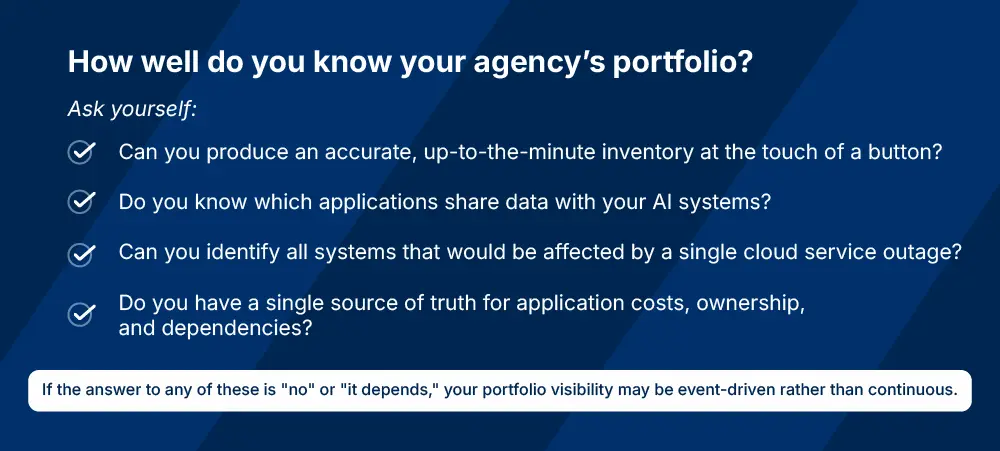
Diagnostic checklist for assessing continuous application portfolio visibility in government IT, including questions about inventory speed, AI system dependencies, cloud service impacts, and single source of truth for application data.

Why Maintaining Application Portfolio Visibility Is Operationally Difficult in Government

Government application portfolios are inherently difficult to map and maintain because they evolve across many systems, programs, and organizational boundaries. These environments rarely exist as neatly maintained inventories. Over time they evolve through successive modernization programs, policy changes, and organizational restructuring, creating technology landscapes that accumulate hidden complexity and technical debt.

FAQs

Application Portfolio Management (APM) is the practice of governing the applications used in an organization. It is an essential strategic planning capability of an IT organization, ensuring that investments in the application landscape are in line with business strategy and that investments are made in a way that minimizes cost and risk, while at the same time delivering the required functionality and flexibility to fulfil business goals.

APM makes visible how applications map to business capabilities, where functional duplication drives unnecessary cost, which technical debt poses the greatest risk, and which dependencies must be managed before change can proceed safely. This visibility allows leaders to prioritize rationalization and modernization based on portfolio-wide impact rather than isolated business cases, helps teams identify consolidation opportunities during mergers or divestitures, and provides the foundation for cloud migration strategies that balance ROI against risk. When application strategy connects to the wider ecosystem of business capabilities, processes, data, and technology, organizations can plan, design, and govern change with confidence. 

Application rationalization is the structured, repeatable process of evaluating an application portfolio to determine whether individual applications should be retained, modernized, consolidated, migrated, or retired based on business value, technical health, cost, risk, and dependencies.

Without structured rationalization, agencies often struggle to identify which systems support mission services, where duplicative capabilities exist, how costs are distributed across the portfolio, and where operational or cybersecurity risks accumulate. For public sector agencies, application rationalization provides visibility into mission support, functional duplication, cost distribution, and risk exposure. This visibility enables agencies to control IT operating costs, reduce cybersecurity exposure, eliminate redundant systems, and ensure technology investments remain aligned to mission priorities. When executed as a continuous discipline rather than a periodic cleanup exercise, rationalization becomes a strategic capability that supports faster modernization, stronger governance, and more defensible investment decisions. 

Application rationalization is the structured process of evaluating applications to determine whether they should be retained, modernized, consolidated, migrated, or retired. Application Portfolio Management (APM) is the broader discipline of governing applications across their full lifecycle from acquisition through retirement.

Rationalization is a foundational activity within APM, but APM extends beyond periodic assessments to include continuous portfolio visibility, lifecycle governance, investment planning, and alignment with enterprise architecture. When agencies establish authoritative application data and standardized evaluation processes through rationalization, the same foundation supports ongoing APM-adjacent disciplines such as technology portfolio management, strategic portfolio management, and AI governance. Rationalization provides the baseline; APM sustains it as an operational discipline. With purpose-built APM capabilities, Bizzdesign Alfabet enables agencies to initiate rationalization and then extend the same repository and governance workflows into continuous strategic portfolio management. 

Federal agencies allocate approximately 80% of their IT budgets to operating and maintaining existing systems, leaving limited funding for modernization. Application Portfolio Management (APM) addresses this constraint by providing the portfolio visibility needed to identify consolidation opportunities, retire redundant systems, and redirect funding toward higher-value initiatives.

When agencies maintain a continuously updated view of their application landscape through APM, they can evaluate modernization opportunities against a complete understanding of dependencies, costs, and mission alignment. This allows leaders to model the financial impact of portfolio decisions before committing budget, assess cloud migration candidates based on technical health and business value, and prioritize modernization investments that deliver measurable mission outcomes. The Federal CIO Council's Application Rationalization Playbook emphasizes repeatable portfolio assessments and governance processes as the foundation for sustained modernization planning. Bizzdesign Alfabet operationalizes this approach by connecting applications to business capabilities, costs, and technical dependencies within a centralized repository, enabling agencies to sustain modernization as a governed discipline rather than an episodic initiative.

Government agencies face converging oversight demands: FITARA portfolio reviews, FISMA cybersecurity compliance, OMB AI governance requirements, and ongoing modernization and cost control expectations. Meeting these mandates requires a reliable, continuously updated view of the application portfolio, not one that's reconstructed for each oversight cycle.

Without continuous visibility, agencies risk falling behind on statutory requirements. The Government Accountability Office's November 2024 assessment found that many agencies have not consistently met FITARA's requirement to conduct annual IT portfolio reviews. When portfolio visibility is ad hoc or event-driven, agencies spend time revalidating inventories and reconciling dependencies before governance decisions can begin. Continuous visibility allows agencies to respond to oversight requirements, assess modernization opportunities, and evaluate emerging risks without rebuilding the baseline each time.

FISMA requires agencies to maintain inventories of information systems and continuously monitor them for security risks. Application Portfolio Management (APM) provides the continuous portfolio visibility needed to meet this requirement by maintaining up-to-date application inventories, ownership information, and dependency maps.

Without continuous visibility, security teams risk operating without awareness of the full system landscape they're responsible for protecting, making it harder to identify unsupported or vulnerable assets and complicating efforts to prioritize remediation activities across the enterprise. Continuous APM visibility allows security teams to identify vulnerable or unsupported systems faster, understand how security risks may propagate across interconnected applications, and prioritize remediation based on a complete view of the enterprise landscape. 

AI systems don't operate in isolation. They depend on existing applications for data inputs, integrate with legacy platforms, rely on shared infrastructure, and introduce new dependencies across the enterprise. To govern AI responsibly and meet OMB M-25-21 requirements for AI inventories and ongoing reviews, agencies need to understand how AI systems interact with the broader technology landscape. With approximately 3,000 AI use cases and systems reported across federal agencies as of early 2026, this architectural clarity becomes critical to scaling AI adoption responsibly.

Without continuous portfolio visibility, agencies risk delaying governance decisions and making it materially more difficult to scale AI adoption responsibly. Each time agencies must reconstruct the architectural context needed to evaluate AI systems, enterprise architecture teams spend capacity revalidating inventories and reconciling dependencies, consuming capacity that could otherwise be spent assessing where AI can deliver measurable mission impact. Application Portfolio Management (APM) provides the foundation that makes AI inventorying faster, more accurate, and aligned with enterprise modernization priorities. 

As federal AI adoption accelerates, with approximately 3,000 AI use cases reported as of early 2026, agencies face growing pressure to scale AI responsibly while managing operational, financial, and security risks. Generative AI systems introduce unique governance challenges because they depend on underlying application architectures, integrate with legacy platforms, consume data from multiple sources, and often rely on third-party cloud services.

Without continuous portfolio visibility, agencies risk deploying AI systems without fully understanding their dependencies, data lineage, or potential security exposure. Application Portfolio Management (APM) provides the architectural clarity needed to evaluate where generative AI can deliver mission value and where it may introduce unintended risks. By maintaining an authoritative view of AI usage in applications, data flows, and infrastructure dependencies, agencies can assess AI initiatives within the broader enterprise context, identify which existing systems will interact with AI workloads, evaluate whether data quality and governance controls are sufficient to support responsible AI use, and ensure AI investments align with existing modernization priorities rather than creating fragmented technology landscapes. This foundation supports the ongoing AI inventories and risk assessments required under OMB M-25-21 guidance. 

Spreadsheet-based approaches typically fail because they cannot maintain continuously updated application inventories, enforce governance workflows, or support repeatable assessment and decision processes at enterprise scale. Spreadsheets may capture a snapshot for a specific oversight cycle, but they cannot maintain real-time dependencies, track changes across organizational boundaries, or connect applications to business capabilities, costs, and risks. As portfolios grow and modernization accelerates, spreadsheet-based rationalization becomes unsustainable.

A purpose-built Application Portfolio Management (APM) platform such as Bizzdesign Alfabet centralizes portfolio data, integrates with existing systems (financial databases, CMDBs, cloud management platforms), automates assessments, enables collaboration across stakeholders, and converts analysis into governed portfolio actions. This allows agencies to sustain portfolio visibility as an operational discipline rather than a periodic reporting exercise. 

Agencies evaluating Application Portfolio Management (APM) platforms should prioritize capabilities that support continuous portfolio visibility, repeatable governance processes, and integration with existing enterprise systems. Essential capabilities include:

  • A centralized application repository serving as the authoritative source of portfolio information.
  • Continuous data synchronization with existing systems (CMDBs, asset inventories, financial systems).
  • Workflow-based questionnaires with ownership assignment and validation controls.
  • Role-based access ensuring application owners can update systems they manage while maintaining governance.
  • Built-in analytics and dependency visualization for multidimensional portfolio analysis.
  • Integrated financial views mapping costs to applications, services, and business capabilities.
  • Centralized scoring logic ensuring consistent evaluation criteria across departments.
  • Portfolio evaluation frameworks (e.g., TIME: Tolerate, Invest, Migrate, Eliminate).
  • Program portfolio management linking application portfolio decisions to funded initiatives.

Additionally, FedRAMP authorization is a foundational requirement for US government agencies. 

Bizzdesign Alfabet addresses these requirements. It also offers a preconfigured alignment to the CIO Council Application Rationalization Playbook, out-of-the-box integrations with ServiceNow and other enterprise systems, and a centralized repository that connects applications to mission services, costs, risks, and dependencies. 

Establishing continuous portfolio visibility requires shifting from episodic inventory exercises to sustained governance practices supported by the right platform, processes, and organizational commitment.  

Agencies should begin by designating an authoritative system of record for application portfolio data. This centralized repository becomes the foundation for all portfolio decisions and governance activities. Next, agencies must establish integration pathways that enable continuous data synchronization between the portfolio repository and existing systems such as financial databases, CMDBs, cloud management platforms, and procurement systems. These integrations eliminate the need for manual reconciliation and ensure portfolio data remains current without requiring teams to reconstruct inventories for each oversight cycle.

Governance policies must reinforce the practice operationally. Agencies should align assessment frameworks to recognized methodologies such as the Federal CIO Council Application Rationalization Playbook, which provides standardized evaluation criteria and repeatable processes.

Finally, agencies must build cross-functional participation across business owners, technical teams, security personnel, and financial stakeholders. Purpose-built APM platforms such as Bizzdesign Alfabet enable this collaboration by providing role-based access, standardized workflows, and enterprise-wide dashboards that make portfolio data accessible across organizational boundaries.

FedRAMP (Federal Risk and Authorization Management Program) provides standardized security assessment, authorization, and continuous monitoring for cloud service providers. OMB policy requires federal agencies to use FedRAMP-authorized cloud services when deploying cloud solutions that process federal data.

For agencies adopting cloud-based Application Portfolio Management (APM) platforms, FedRAMP authorization ensures that these platforms meet federal security requirements based on NIST standards and FISMA-aligned controls, supporting the secure handling of sensitive portfolio data (including sensitive information about system architectures, costs, dependencies, and vulnerabilities).It also provides value to agencies in reducing the required workload and shortening the timeline for achieving ATO (Authority to Operate) through inherited security controls. 

Bizzdesign Alfabet is an Application Portfolio Management (APM) that operationalizes the CIO Council Playbook through the Application Rationalization Accelerator for U.S. Government, a preconfigured solution aligned to the Playbook's six-step methodology.

The Accelerator enables agencies to initiate structured portfolio analysis shortly after implementation by providing standardized assessment attributes, scoring logic, and reporting structures. Out-of-the-box integrations with ServiceNow (CMDB), Flexera ITpedia (technology catalogue), and enterprise architecture repositories enable continuous data synchronization without custom development.

Unlike spreadsheets or operational tools, Bizzdesign Alfabet connects applications to mission services, costs, risks, and dependencies within a centralized repository. This allows agencies to sustain rationalization as an ongoing discipline, respond to oversight requirements without rebuilding the portfolio baseline, and extend the same foundation into technology portfolio management, strategic portfolio management, and AI governance. 

 
Maintain Visibility. Strengthen Governance. Deliver Mission Value.

Govern your application portfolio to control costs, strengthen cybersecurity, and scale AI adoption responsibly.

Application Rationalization for Government Agencies

Application Rationalization for Government Agencies

How to operationalize the CIO Council’s Application Rationalization Playbook with a purpose-built platform

A Buyer’s Guide to Platforms Supporting the CIO Council Playbook 

When government agencies face simultaneous mandates to reduce IT operating costs, accelerate cloud modernization, and strengthen cybersecurity resilience, all three priorities converge on a single capability: continuous visibility into the application portfolio, knowing precisely which applications are in use, what they cost, what mission services they support, what risk they carry, and whether they remain necessary. 

FAQs

Agencies without visibility into their application portfolios typically fund duplicate capabilities across departments, accumulate technical debt from underutilized systems, and lack the data needed to challenge new procurement requests. Application rationalization reduces IT operating costs by identifying redundant applications, consolidating overlapping capabilities, retiring underutilized systems, and preventing duplicate procurements before they occur.

Direct savings come from reducing licensing, hosting, maintenance, and support costs for systems that are retired or consolidated. However, cost avoidance through governance controls often exceeds direct savings over multi-year periods. When intake processes require visibility into the existing portfolio before approving new purchases, agencies avoid funding duplicate capabilities, preventing costs that would otherwise accumulate across licensing, integration, and support. Platforms such as Bizzdesign Alfabet enable agencies to connect cost data directly to applications, business capabilities, and mission services, making these savings measurable and defensible.
 

Application rationalization typically follows a structured evaluation process that assesses applications across business value, technical health, cost, and risk. The CIO Council Application Rationalization Playbook outlines a widely adopted six-step methodology:

  • Identify needs and conduct readiness assessment: Define scope, stakeholders, and initial portfolio baseline
  • Inventory applications: Collect structured data on applications, ownership, and mission alignment
  • Assess business value and technical fit: Evaluate mission relevance, technical health, and risk exposure
  • Assess total cost of ownership: Map costs to applications, services, and business capabilities
  • Score applications: Apply consistent evaluation criteria to determine relative priority
  • Determine application placement: Decide whether systems should be retained, modernized, consolidated, migrated, or retired

These steps provide a repeatable framework that agencies can adapt to their specific missions, compliance requirements, and operational contexts. The Bizzdesign Alfabet Application Rationalization Accelerator for U.S. Government operationalizes this six-step methodology through preconfigured assessment attributes, scoring logic, and reporting structures aligned to the Playbook.
 

Agencies attempting rationalization with spreadsheets or general-purpose tools typically encounter version control problems, data quality issues, and collaboration bottlenecks that make portfolio assessments difficult to sustain beyond a single cycle. A purpose-built application rationalization platform should provide the infrastructure needed to execute the CIO Council Application Rationalization Playbook at scale while maintaining authoritative portfolio data as an operational discipline.

Essential platform capabilities include a centralized application repository serving as the authoritative source of portfolio information, continuous data synchronization with existing systems such as CMDBs and financial databases, workflow-based questionnaires with ownership assignment and validation controls, built-in analytics and dependency visualization for multidimensional portfolio analysis, integrated financial views mapping costs to applications and business capabilities, and centralized scoring logic ensuring consistent evaluation criteria across departments. For federal agencies, FedRAMP authorization is a requirement. 
 

The CIO Council Application Rationalization Playbook provides a proven six-step methodology, but executing it at scale requires more than process documentation. Without dedicated infrastructure, teams often build custom spreadsheets for each assessment cycle, leading to inconsistent evaluation criteria, data quality problems, and portfolio baselines that become outdated before leadership can act on them.

Operationalizing the Playbook requires infrastructure that supports each step with minimal custom development: centralized application intelligence and data integration for readiness assessment, workflow-driven questionnaires for inventory collection, configurable scoring models and dependency visualization for business and technical evaluation, integrated financial mapping for total cost of ownership analysis, transparent scoring logic for consistent application scoring, and structured evaluation models that link rationalization outcomes to funded initiatives. Bizzdesign Alfabet's Application Rationalization Accelerator for U.S. Government operationalizes the Playbook's methodology as a preconfigured platform solution aligned to each step. 
 

Application rationalization is the structured process of evaluating applications to determine whether they should be retained, modernized, consolidated, migrated, or retired. Application Portfolio Management (APM) is the broader discipline of governing applications across their full lifecycle from acquisition through retirement.

Rationalization is a foundational activity within APM, but APM extends beyond periodic assessments to include continuous portfolio visibility, lifecycle governance, investment planning, and alignment with enterprise architecture. When agencies establish authoritative application data and standardized evaluation processes through rationalization, the same foundation supports ongoing APM disciplines such as technology portfolio management, strategic portfolio management, and AI governance. Rationalization provides the baseline; APM sustains it as an operational discipline. Bizzdesign Alfabet functions as a purpose-built APM platform that enables agencies to initiate rationalization and then extend the same repository and governance workflows into continuous portfolio management. 
 

Agencies that treat rationalization as a one-time project typically see portfolio data become outdated within months, forcing them to rebuild inventories from scratch for each oversight cycle or modernization initiative. Application rationalization should function as a continuous governance discipline supported by periodic assessment cycles, not as a one-time cleanup exercise.

Many agencies conduct structured rationalization reviews annually or semi-annually to reassess portfolio health, update placement decisions, and align investments with evolving mission priorities. However, sustaining rationalization outcomes requires maintaining continuously updated portfolio data and governance workflows between review cycles. This allows agencies to respond to new mandates, evaluate modernization opportunities, and prevent duplicate procurements without rebuilding the portfolio baseline from scratch. As the CIO Council Application Rationalization Playbook states, "Application rationalization isn't a one-time exercise but should become part of normal business operations within the agency."

The CIO Council Application Rationalization Playbook provides a standardized six-step methodology covering readiness assessment, application inventory, business and technical evaluation, cost analysis, scoring, and placement decisions. It establishes common terminology, repeatable evaluation processes, and shared decision frameworks so agencies can make consistent, defensible portfolio decisions across departments and programs.

The Playbook balances structure with flexibility. Agencies follow the same foundational process while adapting scoring models, prioritization criteria, and decision thresholds to their specific missions and operational contexts. This makes the Playbook applicable across federal, state, and municipal organizations regardless of portfolio size or complexity. By providing a proven framework, the Playbook reduces the need to design rationalization methodology from scratch and enables agencies to focus on execution rather than process design. Bizzdesign Alfabet's Application Rationalization Accelerator implements the Playbook's methodology into a preconfigured platform solution, allowing agencies to begin structured assessments shortly after implementation.

Spreadsheet-based approaches typically fail because they cannot maintain continuously updated application inventories, enforce governance workflows, or support repeatable assessment and decision processes at enterprise scale. Spreadsheets may capture a snapshot for a specific oversight cycle, but they cannot maintain real-time dependencies, track changes across organizational boundaries, or connect applications to business capabilities, costs, and risks. As portfolios grow and modernization accelerates, spreadsheet-based rationalization becomes unsustainable.

A purpose-built Application Portfolio Management (APM) platform such as Bizzdesign Alfabet centralizes portfolio data, integrates with existing systems (financial databases, CMDBs, cloud management platforms), automates assessments, enables collaboration across stakeholders, and converts analysis into governed portfolio actions. This allows agencies to sustain portfolio visibility as an operational discipline rather than a periodic reporting exercise. 
 

Agencies executing structured, continuous rationalization typically achieve six core outcomes:

  • Cost efficiency through consolidation: Identifying and retiring redundant applications reduces licensing, maintenance, hosting, and support costs while freeing budget for modernization.
  • Greater agility with a leaner portfolio: A streamlined application landscape reduces operational complexity and enables faster delivery of new capabilities.
  • Reduced operational and security risk: Fewer unnecessary systems mean fewer vulnerabilities, failure points, and compliance exposures.
  • Stronger, data-driven decision-making: Reliable portfolio data enables more defensible decisions on investment, retirement, and modernization.
  • Improved compliance and audit readiness: Understanding which applications support regulated processes and where sensitive data resides simplifies reporting and reduces audit burden.
  • Enhanced business and IT collaboration: Shared portfolio views and consistent evaluation criteria align stakeholders around prioritization and resource allocation.

These benefits compound over time when rationalization operates as a continuous discipline rather than a periodic project. Bizzdesign Alfabet supports all six outcomes through centralized portfolio visibility, workflow-driven assessment processes, and integration with enterprise architecture and governance processes.

Agencies that conduct rationalization in isolation without connecting application data to broader architecture and governance processes often find that portfolio insights remain siloed and fail to inform investment decisions, technology standards, or modernization roadmaps. Once agencies establish authoritative application data and standardized evaluation processes through rationalization, the same foundation supports broader portfolio governance disciplines.

Application rationalization provides the baseline inventory and assessment framework that extends into technology portfolio management (identifying redundant or unsupported technologies), strategic portfolio management (aligning investments with mission priorities), AI portfolio management (governing AI use cases and dependencies), and investment approval workflows (evaluating proposed initiatives based on portfolio impact).

This makes rationalization the starting point for continuous, enterprise-wide technology governance rather than a one-time cleanup exercise. Agencies that operationalize rationalization as an ongoing discipline gain the infrastructure needed to govern technology investments across their full lifecycle. Bizzdesign Alfabet's centralized enterprise architecture repository enables agencies to connect application rationalization directly to business capability models, technology standards, strategic initiatives, and compliance requirements.

Without structured portfolio visibility, IT governance decisions often rely on incomplete information, inconsistent evaluation criteria, and fragmented data across departments. This makes it difficult for leadership to assess whether proposed investments duplicate existing capabilities, align with mission priorities, or introduce unnecessary risk. Oversight bodies face extended timelines when requesting portfolio information for audits or compliance reviews.

Application rationalization establishes authoritative portfolio data and standardized evaluation processes that strengthen governance across the investment lifecycle. When intake processes require visibility into the existing portfolio before approving new purchases, agencies prevent duplicate procurements and ensure investments align with architectural standards. Centralized application data improves audit readiness by providing clear visibility into which applications support regulated processes, where sensitive data resides, and how systems interconnect. Consistent scoring criteria and transparent decision frameworks make investment prioritization more defensible to leadership, oversight bodies, and stakeholders.

Agencies that migrate applications to the cloud without structured portfolio visibility risk migrating systems that should be retired, underestimating migration complexity due to hidden dependencies, or selecting migration strategies that don't align with long-term portfolio goals. Cloud migration decisions require understanding which applications support mission services, what they cost to operate, how technically healthy they are, and how they interconnect with other systems.

Application rationalization provides the authoritative data and dependency visibility needed to prioritize applications for migration, modernization, or retirement before cloud investments are made. It enables agencies to model migration scenarios, assess total cost of ownership across cloud and on-premise environments, and identify which applications are suitable for rehosting, refactoring, or replacement. This reduces migration risk, shortens planning cycles, and improves the likelihood that cloud investments deliver expected outcomes.

Cloud modernization requires understanding application dependencies, costs, technical health, and mission alignment before migration decisions are made. Without structured portfolio visibility, agencies risk migrating applications that should be retired, underestimating migration complexity due to hidden dependencies, or selecting migration strategies that don't align with long-term portfolio goals.

Continuous rationalization provides the authoritative data and dependency visibility needed to prioritize applications for migration, modernization, or retirement. It enables agencies to model migration scenarios, assess total cost of ownership across cloud and on-premise environments, and identify which applications are suitable for rehosting, refactoring, or replacement. This reduces migration risk, shortens planning cycles, and improves the likelihood that cloud investments deliver expected outcomes. Bizzdesign Alfabet supports cloud modernization by connecting applications to infrastructure dependencies and enabling agencies to model migration scenarios.

Federal cost-reduction initiatives such as PortfolioStat require agencies to demonstrate measurable progress in reducing IT spending, eliminating redundant systems, and improving portfolio efficiency. Without authoritative portfolio data, agencies struggle to identify consolidation opportunities, quantify savings, or report progress consistently across assessment cycles. The PortfolioStat initiative has generated over $2.57 billion in savings and cost avoidance since 2012, demonstrating the value of structured portfolio governance.

Application rationalization provides the visibility and decision frameworks needed to support these initiatives. By identifying redundant applications, consolidating overlapping capabilities, and retiring underutilized systems, agencies achieve direct cost reductions in licensing, hosting, maintenance, and support. Cost avoidance through governance controls often exceeds direct savings over multi-year periods: when intake processes prevent duplicate procurements before they occur, agencies avoid costs that would otherwise accumulate across licensing, integration, and support. Continuous rationalization enables agencies to report portfolio health metrics, track consolidation progress, and demonstrate measurable outcomes to oversight bodies and leadership.

AI systems don't operate in isolation but depend on existing applications for data inputs, integrate with legacy platforms, rely on shared infrastructure, and introduce new dependencies across the enterprise. Agencies that lack visibility into these dependencies struggle to inventory AI use cases accurately, assess where AI introduces operational or security risk, or prevent fragmented AI investments across departments. Application rationalization supports AI governance by providing authoritative visibility into applications, data dependencies, infrastructure, and risk exposure across the portfolio.

To govern AI responsibly and meet requirements such as OMB M-25-21 (which directs agencies to inventory AI use cases and conduct ongoing reviews), agencies need to understand how AI systems interact with the broader technology landscape. Continuous rationalization provides the architectural context needed to inventory AI systems accurately, evaluate where they introduce operational or security risk, align AI initiatives with modernization priorities, and prevent fragmented AI investments across the organization. Bizzdesign Alfabet enables agencies to extend application rationalization into AI portfolio management by connecting AI use cases to the applications, data sources, and business capabilities they depend on.

Bizzdesign’s Alfabet is an Application Portfolio Management (APM) platform that operationalizes the CIO Council Playbook through the Application Rationalization Accelerator for U.S. Government, a preconfigured solution aligned to the Playbook's six-step methodology.

The Accelerator enables agencies to initiate structured portfolio analysis shortly after implementation by providing standardized assessment attributes, scoring logic, and reporting structures. Out-of-the-box integrations with ServiceNow (CMDB), Flexera ITpedia (technology catalogs), and enterprise architecture repositories enable continuous data synchronization without custom development.

Unlike spreadsheets or operational tools, Bizzdesign Alfabet connects applications to mission services, costs, risks, and dependencies within a centralized repository. This allows agencies to sustain rationalization as an ongoing discipline, respond to oversight requirements without rebuilding the portfolio baseline, and extend the same foundation into technology portfolio management, strategic portfolio management, and AI governance. 

 
 
Ready to Move Beyond Spreadsheet-Based Rationalization?

See how the Bizzdesign Application Rationalization Accelerator delivers measurable cost avoidance, faster modernization, and stronger mission delivery.

Confirmation | Where Strategy Meets EA

Confirmation | Where Strategy Meets EA

Thank you for registering for our webinar on 5th May!

Your registration is confirmed. You’ll receive an email shortly with all the login details.

See you then!

The Bizzdesign Team