Application Rationalization for Government Agencies

Application Rationalization for Government Agencies

How to operationalize the CIO Council’s Application Rationalization Playbook with a purpose-built platform


A Buyer’s Guide to Platforms Supporting the CIO Council Playbook 

When government agencies face simultaneous mandates to reduce IT operating costs, accelerate cloud modernization, and strengthen cybersecurity resilience, all three priorities converge on a single capability: continuous visibility into the application portfolio, knowing precisely which applications are in use, what they cost, what mission services they support, what risk they carry, and whether they remain necessary. 

FAQs

Agencies without visibility into their application portfolios typically fund duplicate capabilities across departments, accumulate technical debt from underutilized systems, and lack the data needed to challenge new procurement requests. Application rationalization reduces IT operating costs by identifying redundant applications, consolidating overlapping capabilities, retiring underutilized systems, and preventing duplicate procurements before they occur.

Direct savings come from reducing licensing, hosting, maintenance, and support costs for systems that are retired or consolidated. However, cost avoidance through governance controls often exceeds direct savings over multi-year periods. When intake processes require visibility into the existing portfolio before approving new purchases, agencies avoid funding duplicate capabilities, preventing costs that would otherwise accumulate across licensing, integration, and support. Platforms such as Bizzdesign Alfabet enable agencies to connect cost data directly to applications, business capabilities, and mission services, making these savings measurable and defensible.
 

Application rationalization typically follows a structured evaluation process that assesses applications across business value, technical health, cost, and risk. The CIO Council Application Rationalization Playbook outlines a widely adopted six-step methodology:

  • Identify needs and conduct readiness assessment: Define scope, stakeholders, and initial portfolio baseline
  • Inventory applications: Collect structured data on applications, ownership, and mission alignment
  • Assess business value and technical fit: Evaluate mission relevance, technical health, and risk exposure
  • Assess total cost of ownership: Map costs to applications, services, and business capabilities
  • Score applications: Apply consistent evaluation criteria to determine relative priority
  • Determine application placement: Decide whether systems should be retained, modernized, consolidated, migrated, or retired

These steps provide a repeatable framework that agencies can adapt to their specific missions, compliance requirements, and operational contexts. The Bizzdesign Alfabet Application Rationalization Accelerator for U.S. Government operationalizes this six-step methodology through preconfigured assessment attributes, scoring logic, and reporting structures aligned to the Playbook.
 

Agencies attempting rationalization with spreadsheets or general-purpose tools typically encounter version control problems, data quality issues, and collaboration bottlenecks that make portfolio assessments difficult to sustain beyond a single cycle. A purpose-built application rationalization platform should provide the infrastructure needed to execute the CIO Council Application Rationalization Playbook at scale while maintaining authoritative portfolio data as an operational discipline.

Essential platform capabilities include a centralized application repository serving as the authoritative source of portfolio information, continuous data synchronization with existing systems such as CMDBs and financial databases, workflow-based questionnaires with ownership assignment and validation controls, built-in analytics and dependency visualization for multidimensional portfolio analysis, integrated financial views mapping costs to applications and business capabilities, and centralized scoring logic ensuring consistent evaluation criteria across departments. For federal agencies, FedRAMP authorization is a requirement. 
 

The CIO Council Application Rationalization Playbook provides a proven six-step methodology, but executing it at scale requires more than process documentation. Without dedicated infrastructure, teams often build custom spreadsheets for each assessment cycle, leading to inconsistent evaluation criteria, data quality problems, and portfolio baselines that become outdated before leadership can act on them.

Operationalizing the Playbook requires infrastructure that supports each step with minimal custom development: centralized application intelligence and data integration for readiness assessment, workflow-driven questionnaires for inventory collection, configurable scoring models and dependency visualization for business and technical evaluation, integrated financial mapping for total cost of ownership analysis, transparent scoring logic for consistent application scoring, and structured evaluation models that link rationalization outcomes to funded initiatives. Bizzdesign Alfabet's Application Rationalization Accelerator for U.S. Government operationalizes the Playbook's methodology as a preconfigured platform solution aligned to each step. 
 

Application rationalization is the structured process of evaluating applications to determine whether they should be retained, modernized, consolidated, migrated, or retired. Application Portfolio Management (APM) is the broader discipline of governing applications across their full lifecycle from acquisition through retirement.

Rationalization is a foundational activity within APM, but APM extends beyond periodic assessments to include continuous portfolio visibility, lifecycle governance, investment planning, and alignment with enterprise architecture. When agencies establish authoritative application data and standardized evaluation processes through rationalization, the same foundation supports ongoing APM disciplines such as technology portfolio management, strategic portfolio management, and AI governance. Rationalization provides the baseline; APM sustains it as an operational discipline. Bizzdesign Alfabet functions as a purpose-built APM platform that enables agencies to initiate rationalization and then extend the same repository and governance workflows into continuous portfolio management. 
 

Agencies that treat rationalization as a one-time project typically see portfolio data become outdated within months, forcing them to rebuild inventories from scratch for each oversight cycle or modernization initiative. Application rationalization should function as a continuous governance discipline supported by periodic assessment cycles, not as a one-time cleanup exercise.

Many agencies conduct structured rationalization reviews annually or semi-annually to reassess portfolio health, update placement decisions, and align investments with evolving mission priorities. However, sustaining rationalization outcomes requires maintaining continuously updated portfolio data and governance workflows between review cycles. This allows agencies to respond to new mandates, evaluate modernization opportunities, and prevent duplicate procurements without rebuilding the portfolio baseline from scratch. As the CIO Council Application Rationalization Playbook states, "Application rationalization isn't a one-time exercise but should become part of normal business operations within the agency."

The CIO Council Application Rationalization Playbook provides a standardized six-step methodology covering readiness assessment, application inventory, business and technical evaluation, cost analysis, scoring, and placement decisions. It establishes common terminology, repeatable evaluation processes, and shared decision frameworks so agencies can make consistent, defensible portfolio decisions across departments and programs.

The Playbook balances structure with flexibility. Agencies follow the same foundational process while adapting scoring models, prioritization criteria, and decision thresholds to their specific missions and operational contexts. This makes the Playbook applicable across federal, state, and municipal organizations regardless of portfolio size or complexity. By providing a proven framework, the Playbook reduces the need to design rationalization methodology from scratch and enables agencies to focus on execution rather than process design. Bizzdesign Alfabet's Application Rationalization Accelerator implements the Playbook's methodology into a preconfigured platform solution, allowing agencies to begin structured assessments shortly after implementation.

Spreadsheet-based approaches typically fail because they cannot maintain continuously updated application inventories, enforce governance workflows, or support repeatable assessment and decision processes at enterprise scale. Spreadsheets may capture a snapshot for a specific oversight cycle, but they cannot maintain real-time dependencies, track changes across organizational boundaries, or connect applications to business capabilities, costs, and risks. As portfolios grow and modernization accelerates, spreadsheet-based rationalization becomes unsustainable.

A purpose-built Application Portfolio Management (APM) platform such as Bizzdesign Alfabet centralizes portfolio data, integrates with existing systems (financial databases, CMDBs, cloud management platforms), automates assessments, enables collaboration across stakeholders, and converts analysis into governed portfolio actions. This allows agencies to sustain portfolio visibility as an operational discipline rather than a periodic reporting exercise. 
 

Agencies executing structured, continuous rationalization typically achieve six core outcomes:

  • Cost efficiency through consolidation: Identifying and retiring redundant applications reduces licensing, maintenance, hosting, and support costs while freeing budget for modernization.
  • Greater agility with a leaner portfolio: A streamlined application landscape reduces operational complexity and enables faster delivery of new capabilities.
  • Reduced operational and security risk: Fewer unnecessary systems mean fewer vulnerabilities, failure points, and compliance exposures.
  • Stronger, data-driven decision-making: Reliable portfolio data enables more defensible decisions on investment, retirement, and modernization.
  • Improved compliance and audit readiness: Understanding which applications support regulated processes and where sensitive data resides simplifies reporting and reduces audit burden.
  • Enhanced business and IT collaboration: Shared portfolio views and consistent evaluation criteria align stakeholders around prioritization and resource allocation.

These benefits compound over time when rationalization operates as a continuous discipline rather than a periodic project. Bizzdesign Alfabet supports all six outcomes through centralized portfolio visibility, workflow-driven assessment processes, and integration with enterprise architecture and governance processes.

Agencies that conduct rationalization in isolation without connecting application data to broader architecture and governance processes often find that portfolio insights remain siloed and fail to inform investment decisions, technology standards, or modernization roadmaps. Once agencies establish authoritative application data and standardized evaluation processes through rationalization, the same foundation supports broader portfolio governance disciplines.

Application rationalization provides the baseline inventory and assessment framework that extends into technology portfolio management (identifying redundant or unsupported technologies), strategic portfolio management (aligning investments with mission priorities), AI portfolio management (governing AI use cases and dependencies), and investment approval workflows (evaluating proposed initiatives based on portfolio impact).

This makes rationalization the starting point for continuous, enterprise-wide technology governance rather than a one-time cleanup exercise. Agencies that operationalize rationalization as an ongoing discipline gain the infrastructure needed to govern technology investments across their full lifecycle. Bizzdesign Alfabet's centralized enterprise architecture repository enables agencies to connect application rationalization directly to business capability models, technology standards, strategic initiatives, and compliance requirements.

Without structured portfolio visibility, IT governance decisions often rely on incomplete information, inconsistent evaluation criteria, and fragmented data across departments. This makes it difficult for leadership to assess whether proposed investments duplicate existing capabilities, align with mission priorities, or introduce unnecessary risk. Oversight bodies face extended timelines when requesting portfolio information for audits or compliance reviews.

Application rationalization establishes authoritative portfolio data and standardized evaluation processes that strengthen governance across the investment lifecycle. When intake processes require visibility into the existing portfolio before approving new purchases, agencies prevent duplicate procurements and ensure investments align with architectural standards. Centralized application data improves audit readiness by providing clear visibility into which applications support regulated processes, where sensitive data resides, and how systems interconnect. Consistent scoring criteria and transparent decision frameworks make investment prioritization more defensible to leadership, oversight bodies, and stakeholders.

Agencies that migrate applications to the cloud without structured portfolio visibility risk migrating systems that should be retired, underestimating migration complexity due to hidden dependencies, or selecting migration strategies that don't align with long-term portfolio goals. Cloud migration decisions require understanding which applications support mission services, what they cost to operate, how technically healthy they are, and how they interconnect with other systems.

Application rationalization provides the authoritative data and dependency visibility needed to prioritize applications for migration, modernization, or retirement before cloud investments are made. It enables agencies to model migration scenarios, assess total cost of ownership across cloud and on-premise environments, and identify which applications are suitable for rehosting, refactoring, or replacement. This reduces migration risk, shortens planning cycles, and improves the likelihood that cloud investments deliver expected outcomes.

Cloud modernization requires understanding application dependencies, costs, technical health, and mission alignment before migration decisions are made. Without structured portfolio visibility, agencies risk migrating applications that should be retired, underestimating migration complexity due to hidden dependencies, or selecting migration strategies that don't align with long-term portfolio goals.

Continuous rationalization provides the authoritative data and dependency visibility needed to prioritize applications for migration, modernization, or retirement. It enables agencies to model migration scenarios, assess total cost of ownership across cloud and on-premise environments, and identify which applications are suitable for rehosting, refactoring, or replacement. This reduces migration risk, shortens planning cycles, and improves the likelihood that cloud investments deliver expected outcomes. Bizzdesign Alfabet supports cloud modernization by connecting applications to infrastructure dependencies and enabling agencies to model migration scenarios.

Federal cost-reduction initiatives such as PortfolioStat require agencies to demonstrate measurable progress in reducing IT spending, eliminating redundant systems, and improving portfolio efficiency. Without authoritative portfolio data, agencies struggle to identify consolidation opportunities, quantify savings, or report progress consistently across assessment cycles. The PortfolioStat initiative has generated over $2.57 billion in savings and cost avoidance since 2012, demonstrating the value of structured portfolio governance.

Application rationalization provides the visibility and decision frameworks needed to support these initiatives. By identifying redundant applications, consolidating overlapping capabilities, and retiring underutilized systems, agencies achieve direct cost reductions in licensing, hosting, maintenance, and support. Cost avoidance through governance controls often exceeds direct savings over multi-year periods: when intake processes prevent duplicate procurements before they occur, agencies avoid costs that would otherwise accumulate across licensing, integration, and support. Continuous rationalization enables agencies to report portfolio health metrics, track consolidation progress, and demonstrate measurable outcomes to oversight bodies and leadership.

AI systems don't operate in isolation but depend on existing applications for data inputs, integrate with legacy platforms, rely on shared infrastructure, and introduce new dependencies across the enterprise. Agencies that lack visibility into these dependencies struggle to inventory AI use cases accurately, assess where AI introduces operational or security risk, or prevent fragmented AI investments across departments. Application rationalization supports AI governance by providing authoritative visibility into applications, data dependencies, infrastructure, and risk exposure across the portfolio.

To govern AI responsibly and meet requirements such as OMB M-25-21 (which directs agencies to inventory AI use cases and conduct ongoing reviews), agencies need to understand how AI systems interact with the broader technology landscape. Continuous rationalization provides the architectural context needed to inventory AI systems accurately, evaluate where they introduce operational or security risk, align AI initiatives with modernization priorities, and prevent fragmented AI investments across the organization. Bizzdesign Alfabet enables agencies to extend application rationalization into AI portfolio management by connecting AI use cases to the applications, data sources, and business capabilities they depend on.

Bizzdesign’s Alfabet is an Application Portfolio Management (APM) platform that operationalizes the CIO Council Playbook through the Application Rationalization Accelerator for U.S. Government, a preconfigured solution aligned to the Playbook's six-step methodology.

The Accelerator enables agencies to initiate structured portfolio analysis shortly after implementation by providing standardized assessment attributes, scoring logic, and reporting structures. Out-of-the-box integrations with ServiceNow (CMDB), Flexera ITpedia (technology catalogs), and enterprise architecture repositories enable continuous data synchronization without custom development.

Unlike spreadsheets or operational tools, Bizzdesign Alfabet connects applications to mission services, costs, risks, and dependencies within a centralized repository. This allows agencies to sustain rationalization as an ongoing discipline, respond to oversight requirements without rebuilding the portfolio baseline, and extend the same foundation into technology portfolio management, strategic portfolio management, and AI governance. 


Ready to Move Beyond Spreadsheet-Based Rationalization?

See how the Bizzdesign Application Rationalization Accelerator delivers measurable cost avoidance, faster modernization, and stronger mission delivery.

The Forrester Wave™: Strategic Portfolio Management Tools, Q2 2026

The Forrester Wave™: Strategic Portfolio Management Tools, Q2 2026

Bizzdesign Is Named a Leader in Strategic Portfolio Management
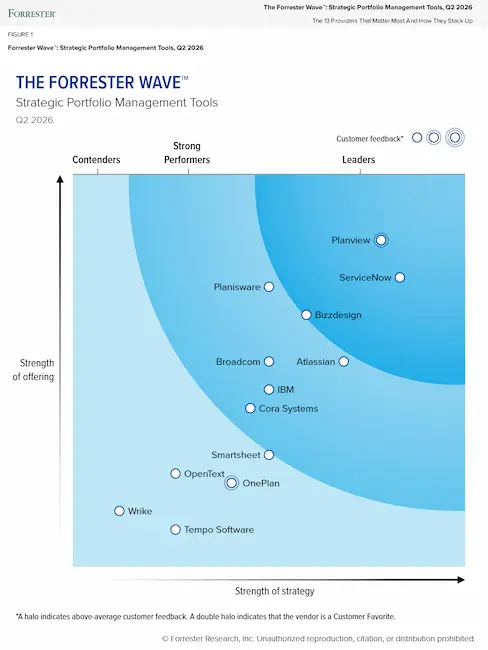
Forrester Wave Strategic Portfolio Management, Q1 2026

Strategic portfolio management (SPM) is essential as organizations work to balance growth and cost while navigating AI complexity, shifting business priorities, and rising demands for alignment between strategy and execution.

The Forrester Wave™: Strategic Portfolio Management Tools, Q2 2026 evaluates 13 market providers. The report shows how they stack up and helps buyers understand necessary capabilities and market trends shaping the SPM discipline.

Get complimentary access to the report to:

CAPTCHA

Why Is Bizzdesign Recognized as a Leader?

Bizzdesign was recognized as a Leader, with strategy, modeling, and capability-based planning noted as key differentiators. The report also notes that Bizzdesign best suits enterprises with complex planning needs and an emphasis on enterprise architecture.

The report noted:

  • Strategy: "AI investment is a significant part of [Bizzdesign’s] standout innovation."
  • Capabilities: "AI capabilities in portfolio management are intuitive and practical."
  • Customer feedback: "Customers cite Bizzdesign’s comprehensive planning and modeling capabilities as key standouts."

Why Do Organizations Choose Bizzdesign?

Bizzdesign is uniquely positioned at the intersection of strategic portfolio management (SPM) and enterprise architecture (EA), and is the only vendor recognized as a leader in the SPM Wave to also be named as a leader in The Forrester Wave™: Enterprise Architecture Management Suites, Q4 2024.

That matters because the market is shifting toward a unified transformation control plane. Forrester’s EA research points to a future where strategy, SPM, EA, and IT finance converge to prioritize and govern technology for business value in an AI-driven world. 

Bizzdesign is built for that shift, combining EA, SPM, and AI capabilities in one Enterprise Transformation Suite.


Forrester does not endorse any company, product, brand, or service included in its research publications and does not advise any person to select the products or services of any company or brand based on the ratings included in such publications. Information is based on the best available resources. Opinions reflect judgment at the time and are subject to change. This report is part of a broader collection of Forrester resources, including interactive models, frameworks, tools, data, and access to analyst guidance. For more information, read about Forrester’s objectivity here.

Confirmation | Webinar portefeuille applicatif et stratégie IT

Confirmation | Webinar portefeuille applicatif et stratégie IT

Merci pour votre inscription à notre webinar « Portefeuille applicatif & stratégie IT : comment Alfabet vous donne une longueur d'avance » du 28 mai 2026.

Vous recevrez prochainement par e-mail tous les détails pour participer à la session.

Pour toute question ou demande, vous pouvez contacter j.ferron@bizzdesign.com.


Confirmation | Where Strategy Meets EA

Confirmation | Where Strategy Meets EA

Thank you for registering for our webinar on 5th May!

Your registration is confirmed. You’ll receive an email shortly with all the login details.

See you then!

The Bizzdesign Team


Confirmation | From Mandate to Action: Governing AI Before It Governs You

Confirmation | From Mandate to Action: Governing AI Before It Governs You

Thank you for registering for our webinar From Mandate to Action: Governing AI Before It Governs You

Your registration has been confirmed! You’ll receive an email shortly with all the details to join the session.

See you on April 9th,

The Bizzdesign Team


Building Resilient Public Sector IT with Bizzdesign Alfabet: Cost Savings, Visibility, and Engagement

Building Resilient Public Sector IT with Bizzdesign Alfabet: Cost Savings, Visibility, and Engagement

Results

  • Enterprise-wide transparency across a highly federated IT landscape (dozens of agencies, hundreds of applications each)
  • Significant cost savings through vendor and contract consolidation.
  • Reduced risk by mapping technologies and dependencies to critical processes
  • Greater business engagement: 200+ active users across IT and agencies, with expansion underway
  • Executive visibility through real-time dashboards for CIO and state leadership

Minnesota IT Services (MNIT) is the central IT agency for the State of Minnesota’s executive branch, with 2,800 employees supporting 38 state agencies and 60 boards and commissions. Formed just over a decade ago to unify previously siloed IT functions, MNIT now provides strategy, governance, and shared services that enable agencies to deliver on their missions.

 
minnesota-it-services
Country United States
Industry Public
Employees 1001 - 5000

Product

Bizzdesign Alfabet

Solution

Application Portfolio Management

Confirmation | Bizzdesign Circle Event - Toronto

Confirmation | Bizzdesign Circle Event - Toronto

Thank you for registering for our Bizzdesign Circle Event in Toronto!

Your registration is confirmed. You’ll receive an email shortly with all event details.

See you in Canada, 

The Bizzdesign Team