
Bizzdesign Unify: An AI-native platform for faster, better transformation decisions.
Use Our Business Process Maturity Model to Measure Progress
Use Our Business Process Maturity Model to Measure Progress
Summary
Whether you are just starting with BPM or looking to optimize advanced processes, using this model ensures your improvement efforts are targeted, structured, and aligned with business goals. With the right insights and tools, you can transform BPM from isolated initiatives into a driver of sustainable enterprise-wide performance.



Expressing the BIAN Reference Model for the Banking Industry in the ArchiMate® Modeling Language
Expressing the BIAN Reference Model for the Banking Industry in the ArchiMate® Modeling Language
Summary
The BIAN® reference model expressed in the ArchiMate® modeling language demonstrates how industry standards can accelerate digital transformation in financial services. By combining BIAN’s structured service domains with ArchiMate®’s modeling capabilities, financial institutions gain a common language to improve interoperability, streamline processes, and strengthen governance. This alignment not only supports compliance and efficiency but also provides a solid foundation for innovation in the evolving financial landscape.


Planning and Roadmapping Modeling in ArchiMate®
Planning and Roadmapping Modeling in ArchiMate®

Linking Capabilities to the Operating Model Business Functions and Organizational Structure
Linking Capabilities to the Operating Model Business Functions and Organizational Structure
Summary
Linking business capabilities to the operating model provides a clear line of sight from strategic intent to operational execution. By distinguishing between capabilities and business functions, and relating them to organizational units, processes, and technology, business architects can build models that are both strategic and actionable. This capability-driven perspective ensures that enterprises stay focused on what they can do, while functions and resources define how they achieve it—creating flexibility, traceability, and long-term business value.
How to Combine ArchiMate® With Industry Standards for Better EA
How to Combine ArchiMate® With Industry Standards for Better EA
Summary
First of all, let’s repeat what we started with: ArchiMate® is not intended to replace other standards and techniques but rather to complement them. For many domains, there are languages and techniques available with a narrower scope but a greater level of detail. ArchiMate® provides a broader description that helps to see the dependencies between different aspects and areas and gives a general overview of your enterprise.
It can connect to those other techniques because their concepts overlap. Since ArchiMate® is only a modeling language, it does not provide its way of working, but it will, of course, be used in the context of such a process. Much has been written about using ArchiMate® with TOGAF®—both Open Group standards and easily complementary—and we did not want to repeat that in this blog.
In addition to this typical use in enterprise architecture, we discussed the relevance of architecture and ArchiMate® in agile development. Although the role of models in an agile approach differs from the traditional ‘big design up front’ development style, they are important in ensuring coherence across different timescales, iterations, and domains.
You need to make sure that agile teams work with and not against each other and avoid creating silos, and you want to align everyone from strategy to operations with the same purpose.
Creating, evolving, and sharing just-in-time models that capture the information necessary to make the right decisions at all levels of the organization at the right moment is the best way to become a truly adaptive enterprise. If you have any further questions about linking ArchiMate® to other standards, please contact us.



The Future of Enterprise Architecture and AI Integration
The Future of Enterprise Architecture and AI Integration


ArchiMate® 3.0 – Grouping and Junctions
ArchiMate® 3.0 – Grouping and Junctions


Busines Model Examples With the Business Model Canvas
Busines Model Examples With the Business Model Canvas
Conclusions and next steps
We described types of analysis, and we zoomed in on analyzing the Business Model Canvas. Analysis of business models answers the question of why and how a venture is or will be, viable and valuable. Based on questions that represent various perspectives on analyzing business models, the Nextpresso case illustrates different approaches to conducting analysis. Choosing the right enterprise architecture tool is essential for business model analyses, making calculations and communication easy. If you would like to see a demo of the Business Model Canvas in Bizzdesign, please contact Bizzdesign's experts for a demo.

5 Process Models Examples and Benefits
5 Process Models Examples and Benefits
Summary
Business Process Management (BPM) empowers process teams with a guided framework for designing, modeling, and managing enterprise-wide process architecture. It includes ready-to-use framework templates and interactive management dashboards that align operational processes with strategic business goals. With this solution, teams can model processes at multiple levels of detail, seamlessly integrated with the broader enterprise architecture to gain critical insights and drive successful transformation initiatives.
Topic: Business process management focuses on how the enterprise operates and delivers the results i.e. products and services to external and internal customers.
Process models represent an abstract view of a business process and serve as a blueprint for implementing or improving it. A process model describes how the process works, what steps are involved, and how those steps are performed.
Process models can be designed in business process management software or enterprise architecture platforms. We advise and promote designing business processes on an enterprise architecture platform, such as Bizzdesign Horizzon, because it helps you to design and execute transformations effectively. The benefits of this are described below.
Benefits of business process models (and examples)
Transparency
Process models help everyone understand the processes that exist within an organization and identify who is responsible and accountable for each activity. It also allows employees to understand the bigger picture better and how their work influences the outcomes and the work of others.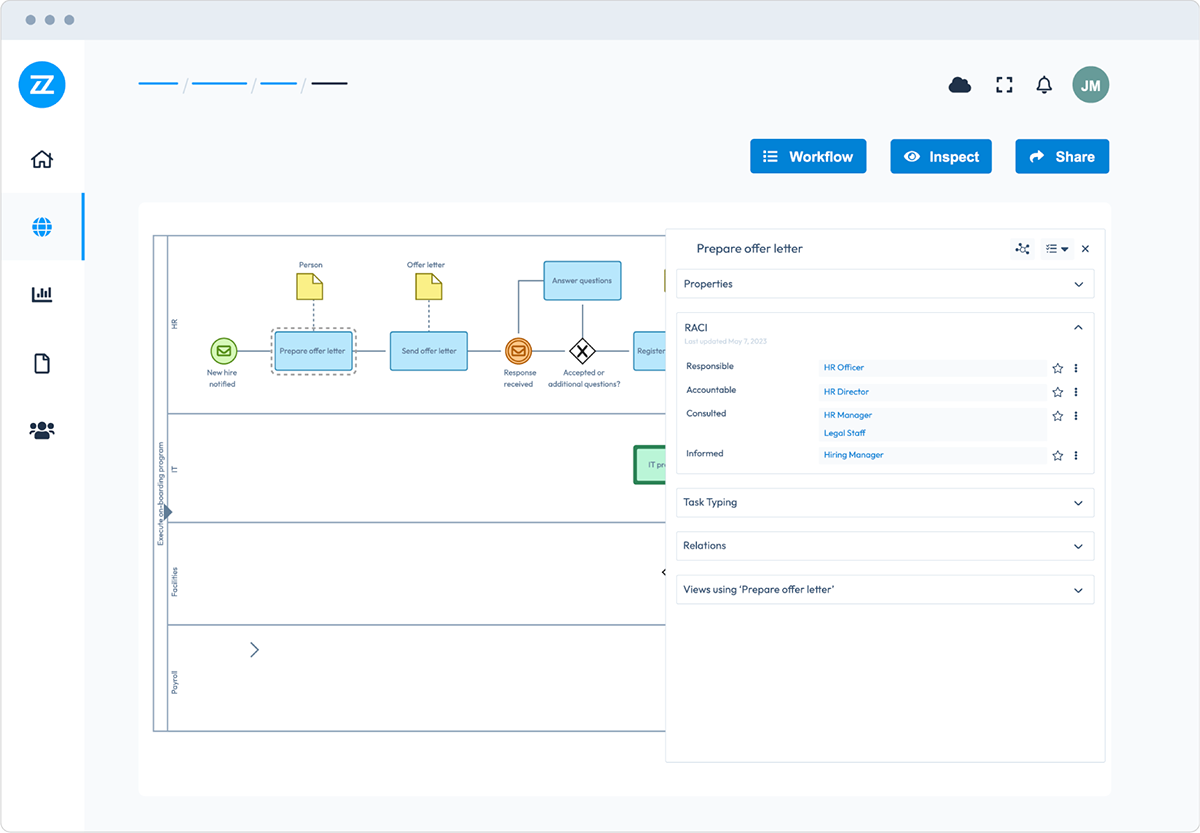

The Best Tools to Create Architecture Diagrams (Cloud, Data, IT & More)
The Best Tools to Create Architecture Diagrams (Cloud, Data, IT & More)
Summary
Choose a single software for architecture diagramming when dealing with smaller projects or limited resources and when simplicity suffices.
On the other hand, opt for an enterprise architecture platform when dealing with architectures, diverse teams, and the need for seamless integration, collaboration, and scalability.
Understand your organization’s specific needs when evaluating a tool’s features. Make a well-informed decision considering not only your current but also your future requirements for scalability.

